
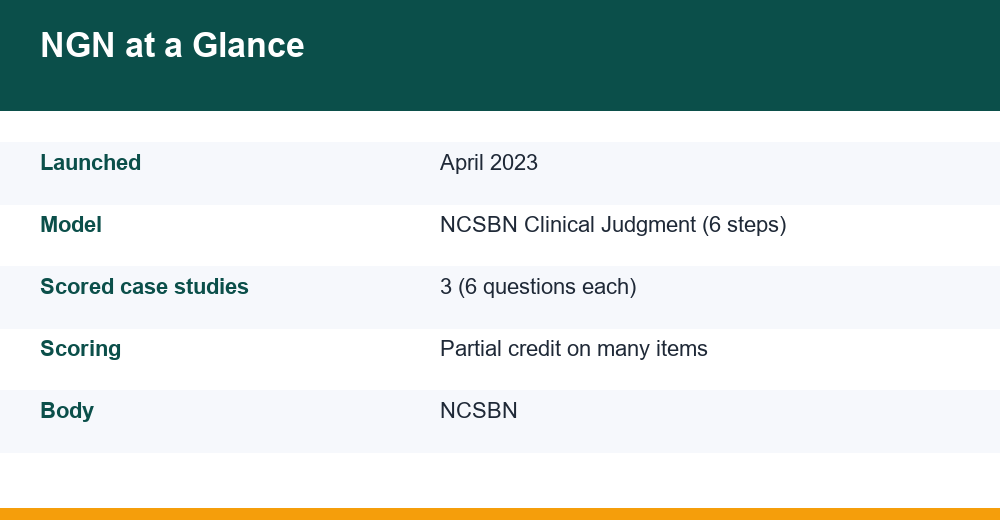
The Next Generation NCLEX, or NGN, is the biggest change to the nursing licensure exam in years, and understanding it is essential to preparing well. Launched in April 2023, the NGN adds realistic case studies and new item types designed to measure clinical judgement — whether you can think like a nurse, not just recall facts. This complete guide explains the clinical judgment model behind the NGN, the new item types, how case studies are structured and scored, and how to approach them.
Table of Contents
What the Next Generation NCLEX is
The NGN is not a different exam — it is the current NCLEX-RN and NCLEX-PN, updated to test clinical judgement more directly. The NCSBN spent years researching why some newly licensed nurses struggle with real-world decision-making, and concluded that the exam needed to measure judgement, not just knowledge. The result is the NGN, which keeps traditional multiple-choice questions but adds case studies and new item formats built around a formal model of how nurses make decisions.
The Clinical Judgment Measurement Model
At the heart of the NGN is the NCSBN Clinical Judgment Measurement Model, which breaks clinical judgement into six steps: recognize cues (notice the relevant information), analyze cues (interpret what it means), prioritize hypotheses (decide what is most likely and most urgent), generate solutions (plan care), take action (implement it), and evaluate outcomes (judge whether it worked). The NGN case studies walk you through all six steps for a single patient, which is why they feel like a realistic clinical encounter rather than isolated questions.
New NGN item types
The NGN introduces several new formats, each designed to capture a step of the judgment model:
- Extended multiple response — select all that apply, often with partial credit.
- Extended drag and drop — move responses into the correct place.
- Cloze (drop-down) — complete sentences by choosing from drop-down menus.
- Highlight — click the relevant words in a passage of text.
- Matrix/grid — mark options across a table of rows and columns.
- Bow-tie — link the condition, actions and parameters to monitor in one integrated item.
- Trend — interpret how a patient’s data changes over time.
Case study structure
A standard NGN exam includes three scored case studies, each with six questions — one question for each step of the clinical judgment model — for a total of eighteen case-study questions. Each case presents an unfolding patient scenario with charts, nurses’ notes and results, and the six questions build on each other as the situation develops. Alongside the case studies, the exam includes stand-alone NGN items and the traditional question types you already know.
How NGN items are scored
A key change with the NGN is partial-credit scoring. Traditional select-all-that-apply questions were all-or-nothing, but many NGN item types award credit for each correct element, using scoring rules such as plus/minus scoring (where wrong selections cancel out some correct ones) or rationale scoring. This means it is worth answering every part of an NGN item thoughtfully rather than leaving it, because partial credit is available. The overall exam is still scored pass or fail using the computer-adaptive logic explained in our guide on how the NCLEX is scored.
How to answer NGN questions
Approach every case study through the lens of the six-step model. First read the scenario and recognize the cues that matter, filtering out the noise. Analyze what those cues indicate, then prioritize the most urgent hypothesis. Only then generate solutions and take action, and finally evaluate whether the action helped. Do not rush to an action before you have interpreted the cues — jumping ahead is the most common mistake. The frameworks in our prioritization and delegation guide are especially useful for the prioritize and take-action steps.
Key takeaways
The Next Generation NCLEX rewards genuine clinical judgement, so preparation should emphasise reasoning through patient scenarios rather than memorising isolated facts. Practise NGN-style case studies, learn the six-step model until it is second nature, and take advantage of partial credit by answering every element. Combine this with our NCLEX study plan, and read the official NGN details on the NCSBN website. Understand the NGN, and the exam’s newest and most intimidating features become its most predictable.
Frequently Asked Questions
What is the Next Generation NCLEX?
The Next Generation NCLEX (NGN) is the version of the exam launched in April 2023 that adds new item types and case studies designed to measure clinical judgment more directly, based on the NCSBN Clinical Judgment Measurement Model.
What are the six steps of the clinical judgment model?
Recognize cues, analyze cues, prioritize hypotheses, generate solutions, take actions, and evaluate outcomes.
What are the new NGN item types?
They include extended multiple response, extended drag and drop, cloze (drop-down), highlight, matrix/grid, and the bow-tie and trend items, in addition to traditional multiple-choice questions.
Do NGN questions have partial credit?
Yes. Many Next Generation item types use partial-credit scoring, so you can earn some credit even if part of your answer is incorrect — a change from all-or-nothing scoring.