
The 2026 NCLEX test plan is the official blueprint NCSBN uses to build every NCLEX-RN and NCLEX-PN exam delivered from April 1, 2026 through March 31, 2029. It tells you which Client Needs categories are tested, how heavily each one is weighted, and how clinical judgment fits in. Below you will find every percentage for both exams, a plain comparison with the 2023 plan, and where the passing standard stands right now.
Table of Contents
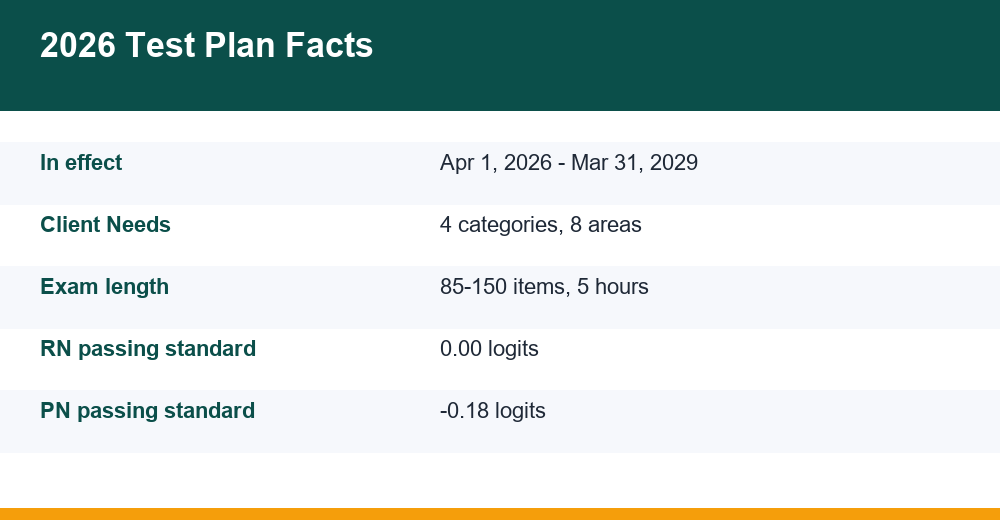
2026 NCLEX test plan at a glance
NCSBN reviews each NCLEX test plan every three years. The cycle starts with a practice analysis: a large survey of newly licensed nurses about which nursing activities they perform, how often, and how much those activities matter for client safety. The RN plan is built on the 2024 RN Practice Analysis, and the PN plan rests on the parallel 2024 LPN/VN Practice Analysis.
The NCLEX Examination Committee drafts the plan from that data, member boards of nursing give feedback, and NCSBN’s Delegate Assembly votes to adopt it. The 2026 plans were approved in 2025, giving schools and candidates several months to prepare before they took effect on April 1, 2026.
When does the 2026 test plan take effect?
The answer is simple: April 1, 2026, for RN and PN candidates alike. It stays in force until March 31, 2029, when the next three-year plan is expected to replace it. Your test date, not your graduation date, decides which plan applies to you.
If you are new to the exam itself, our overview of what the NCLEX is and how licensure works covers the basics first. Here are the facts that matter most about the current blueprint:
- Effective window: April 1, 2026 to March 31, 2029, for both RN and PN candidates.
- Structure: four Client Needs categories split into eight content areas.
- Clinical judgment: three case studies (18 items) plus stand-alone clinical judgment items.
- Length: 85 to 150 items within a five-hour limit that includes breaks.
- Format: computerized adaptive testing (CAT), the same delivery method used under the 2023 plan.
The 2026 NCLEX test plan replaced the 2023 version on its effective date, so anyone testing inside that window is measured against it, regardless of when they graduated or started studying.
What are the four Client Needs categories?
NCSBN uses the Client Needs framework because it describes nursing actions in a way that applies to clients in any setting, from a hospital unit to a home visit. Two of the four categories are divided into subcategories, which is why people talk about “eight content areas” even though there are only four headline categories.
1. Safe and Effective Care Environment
This category covers how the nurse organizes and protects care. On the RN exam it has two parts: Management of Care (delegation, prioritization, advocacy, legal and ethical duties, client rights) and Safety and Infection Prevention and Control (error prevention, standard and transmission-based precautions, safe equipment use, emergency response). The PN exam uses Coordinated Care in place of Management of Care, reflecting the LPN/VN scope of practice.
2. Health Promotion and Maintenance
Growth and development across the lifespan, prenatal and newborn care, screening, health teaching and disease prevention. Expect questions on developmental milestones, immunizations and education about risk factors.
3. Psychosocial Integrity
Mental health conditions, coping, grief and loss, crisis intervention, abuse and neglect, substance use, therapeutic communication, and cultural and spiritual influences on care.
4. Physiological Integrity
The largest category by combined weight, with four subcategories:
- Basic Care and Comfort – mobility, hygiene, nutrition, elimination, rest and non-pharmacological comfort measures.
- Pharmacological and Parenteral Therapies (RN) or Pharmacological Therapies (PN) – medication administration, dosage calculation, adverse effects and, for RNs, IV therapy and blood products.
- Reduction of Risk Potential – lab values, diagnostic tests, changes in vital signs and preventing complications.
- Physiological Adaptation – acute, chronic and life-threatening conditions, fluid and electrolyte imbalances, and medical emergencies.
Six integrated processes run through all of these categories rather than standing alone: caring, clinical judgment, communication and documentation, culture and spirituality, the nursing process, and teaching/learning. Any question, in any category, can lean on one of them.
NCLEX-RN percentages by category
Each content area gets a percentage range, not a fixed number. Because the exam is adaptive and variable in length, NCSBN notes that an individual candidate’s distribution may differ by up to plus or minus 3% in each category. The figures below come from the official RN plan, alongside the 2023 ranges for comparison.
| Client Needs area (RN) | 2026 range | 2023 range |
|---|---|---|
| Management of Care | 15-21% | 15-21% |
| Safety and Infection Prevention and Control | 10-16% | 10-16% (as Safety and Infection Control) |
| Health Promotion and Maintenance | 6-12% | 6-12% |
| Psychosocial Integrity | 6-12% | 6-12% |
| Basic Care and Comfort | 6-12% | 6-12% |
| Pharmacological and Parenteral Therapies | 13-19% | 13-19% |
| Reduction of Risk Potential | 9-15% | 9-15% |
| Physiological Adaptation | 11-17% | 11-17% |
The midpoint of each range gives a useful rough guide. Management of Care is the single heaviest area at about 18%, followed by Pharmacological and Parenteral Therapies at about 16% and Physiological Adaptation at about 14%. Safety and Infection Prevention and Control sits near 13%, Reduction of Risk Potential near 12%, and the remaining three areas around 9% each.
What the numbers mean for RN candidates
Add up the four Physiological Integrity subcategories and you reach roughly half of the content-area items. Management of Care and pharmacology together account for about a third. If your study time is limited, those are the places where weak spots cost the most.
That said, a low-weight area is never optional. CAT keeps pulling items from every category to satisfy the plan, so a candidate who skips psychosocial content will still meet it on exam day, probably more than once.
A worked example
On a minimum-length exam, 52 scored items come from the eight content areas. Using the midpoints as a rough guide, that works out to approximately 9 Management of Care items, 8 pharmacology items, 7 Physiological Adaptation items and about 5 items each from the three 9% areas. These counts are estimates only: CAT keeps each area inside its range, and a longer exam adds more items in roughly the same proportions.
NCLEX-PN percentages and how they differ
The PN exam uses the same four categories but adjusts the weights to match practical/vocational nursing. The most visible difference is Coordinated Care, the PN counterpart to Management of Care, which carries the largest share of the exam.
| Client Needs area (PN) | 2026 range | Approx. midpoint |
|---|---|---|
| Coordinated Care | 18-24% | 21% |
| Safety and Infection Prevention and Control | 10-16% | 13% |
| Health Promotion and Maintenance | 6-12% | 9% |
| Psychosocial Integrity | 9-15% | 12% |
| Basic Care and Comfort | 7-13% | 10% |
| Pharmacological Therapies | 10-16% | 13% |
| Reduction of Risk Potential | 9-15% | 12% |
| Physiological Adaptation | 7-13% | 10% |
Compared with the RN plan, PN candidates see relatively more Coordinated Care, Psychosocial Integrity and Basic Care and Comfort, and relatively less pharmacology and Physiological Adaptation. The pharmacology label also drops the word “Parenteral”, in line with the narrower and state-dependent LPN/VN role in IV therapy.
These PN ranges are identical to the 2023 PN plan. If you are preparing for the practical nursing exam, our NCLEX-PN study guide breaks each of these areas into specific, testable topics.
What changed between the 2023 and 2026 plans?
Less than many candidates expect. NCSBN’s summary of the proposal, presented ahead of the vote in 2025, boils the changes down to five short points:
- Overall format retained.
- Minor edits for currency and clarity.
- Client Needs category percentages retained.
- One Client Needs category name revised.
- New activity statements added.
The renamed subcategory
The only structural change is a name: Safety and Infection Control became Safety and Infection Prevention and Control on both the RN and PN plans. The weight (10-16%) stayed the same. The new wording puts the emphasis on preventing infection, not only containing it once it occurs.
New activity statements
Activity statements are the specific nursing tasks listed under each content area, drawn from the 2024 practice analyses. Some were added and others reworded. They shift what can appear within a category, not how much of the exam that category occupies. Reading the current content lists in the official plan is the only reliable way to see them.
Is older prep material still valid?
Mostly, yes. Because the percentages, exam length, item formats, case study structure and scoring are unchanged, a solid review book or question bank written for the 2023 plan still covers the same blueprint. Watch for three things:
- Material from before April 2023 predates the Next Generation NCLEX and lacks case studies and newer item types, so treat it as content review only.
- Category labels in 2023-era resources will say “Safety and Infection Control”; that content maps directly to the renamed area.
- Check the newest activity statements in the official plan so a task your older resource never mentions does not catch you off guard.
What did not change
It helps to list what stayed fixed, because rumors about a “new NCLEX” circulate every cycle. Under the 2026 NCLEX test plan, the minimum and maximum item counts, the five-hour limit, the three case studies, the 15 unscored pretest items, the stopping rules and the partial-credit scoring methods all match the 2023 rules. The four Client Needs categories, the eight content areas and the six integrated processes are also the same.
Clinical judgment, case studies and exam length
Clinical judgment is measured alongside the eight content areas, using the NCSBN Clinical Judgment Measurement Model. Each case study is a set of six items about one unfolding client situation, and each item targets one of six steps: recognize cues, analyze cues, prioritize hypotheses, generate solutions, take action and evaluate outcomes.
Every candidate receives three case studies. Stand-alone clinical judgment items, such as bow-tie and trend questions, also appear among the content-area items, with the exact number depending on how long the exam runs. The same structure applies to RN and PN candidates.
How a minimum-length exam is built
| Component | Items | Scored? |
|---|---|---|
| Content-area items (eight areas) | 52 | Yes |
| Clinical judgment case studies (3 x 6) | 18 | Yes |
| Pretest items | 15 | No |
| Total minimum | 85 | 70 scored |
The maximum is 150 items, and the five-hour clock includes all breaks. You cannot tell pretest items from scored ones, so treat every question as if it counts. The exam ends when one of three rules applies:
- 95% confidence rule: after the minimum, the computer stops once it is 95% certain your ability is clearly above or below the passing standard. This is the most common way the exam ends.
- Maximum-length rule: if you stay close to the standard, testing continues to 150 items and the final ability estimate decides the result.
- Run-out-of-time rule: if time expires before the minimum is answered, the result is a fail; if the minimum was reached, the final ability estimate decides.
Exam length alone says nothing about passing or failing. Items with more than one correct answer can earn partial credit through plus/minus, zero/one or rationale scoring, depending on the item type.
Did the passing standard change in 2026?
No. The NCLEX does not use a percentage score. Instead, CAT compares your estimated ability against a passing standard expressed in logits, a unit of measurement used in item response theory. NCLEX.com currently lists:
| Exam | Passing standard | Listed as effective through |
|---|---|---|
| NCLEX-RN | 0.00 logits | March 31, 2029 |
| NCLEX-PN | -0.18 logits | March 31, 2029 |
These are the same values that applied under the 2023 plan. NCSBN’s Board of Directors re-evaluates the standard every three years, on the same cycle as the test plan, so the next review will come ahead of the 2029 plan.
When the Board reviews the standard, it weighs four kinds of evidence: results of an expert standard-setting panel, the history of past standards and candidate performance, a standard-setting survey of educators and employers, and information on the educational readiness of high school graduates interested in nursing.
There is also no quota. NCSBN states that no fixed percentage of candidates passes or fails; anyone who performs at or above the standard passes.
How to study with the 2026 NCLEX test plan
The blueprint works best as a checklist rather than a reading assignment. Download the official RN or PN document from the NCLEX test plans page and use it to steer your review:
- Map your weak areas. After a diagnostic practice test, record your results by the eight content areas, not by textbook chapter.
- Weight your hours. Give the high-percentage areas (Management of Care or Coordinated Care, pharmacology, Physiological Adaptation) proportionally more time, but touch every area each week.
- Work the activity statements. Read the sample content under each area and ask whether you could answer a priority question about each task.
- Practice full case studies. Do six-item sets in one sitting so you get used to following a client through all six clinical judgment steps.
- Rehearse under time. Take at least one full-length practice exam with breaks counted against five hours.
A structured calendar keeps this manageable. Our NCLEX study plan shows how to spread the eight content areas across four, six or eight weeks.
Finally, remember that only the official document defines the exam. Commercial summaries sometimes round or regroup the numbers. When a resource disagrees with the 2026 NCLEX test plan published by NCSBN, trust the official plan, which every candidate can download free of charge.
Frequently Asked Questions
When does the current NCLEX test plan take effect?
The current RN and PN test plans took effect on April 1, 2026 and remain in use through March 31, 2029. Anyone sitting the NCLEX during that window is tested against them, no matter when they graduated. NCSBN reviews the plans every three years, so the next version is expected for April 2029.
What percentage of the NCLEX is each Client Needs category?
On the RN exam, Management of Care is 15-21%, Safety and Infection Prevention and Control 10-16%, Health Promotion and Maintenance 6-12%, Psychosocial Integrity 6-12%, Basic Care and Comfort 6-12%, Pharmacological and Parenteral Therapies 13-19%, Reduction of Risk Potential 9-15% and Physiological Adaptation 11-17%. PN weights differ, led by Coordinated Care at 18-24%.
What changed between the 2023 and 2026 NCLEX test plans?
Very little. NCSBN kept the format and every category percentage. The Safety and Infection Control subcategory was renamed Safety and Infection Prevention and Control, new activity statements were added, and wording was edited for currency and clarity. Exam length, case studies, item types and scoring stayed the same.
Did the NCLEX passing standard change in 2026?
No. NCLEX.com lists the NCLEX-RN passing standard at 0.00 logits and the NCLEX-PN standard at -0.18 logits, both effective through March 31, 2029. These are the same values used under the 2023 test plan. There is no percentage cut score; the adaptive exam compares your ability estimate with the standard.