
The Nurse Licensure Compact (NLC) is one of the most practical things a nurse can understand about licensure, because it can let you practise in dozens of states on a single license. This complete guide explains how it works, who is eligible for a multistate license, what it means for telehealth and travel nursing, and how to obtain one. Membership and rules evolve, so always confirm current details with the NCSBN and your board of nursing.
Table of Contents
Nurse Licensure Compact: how it works
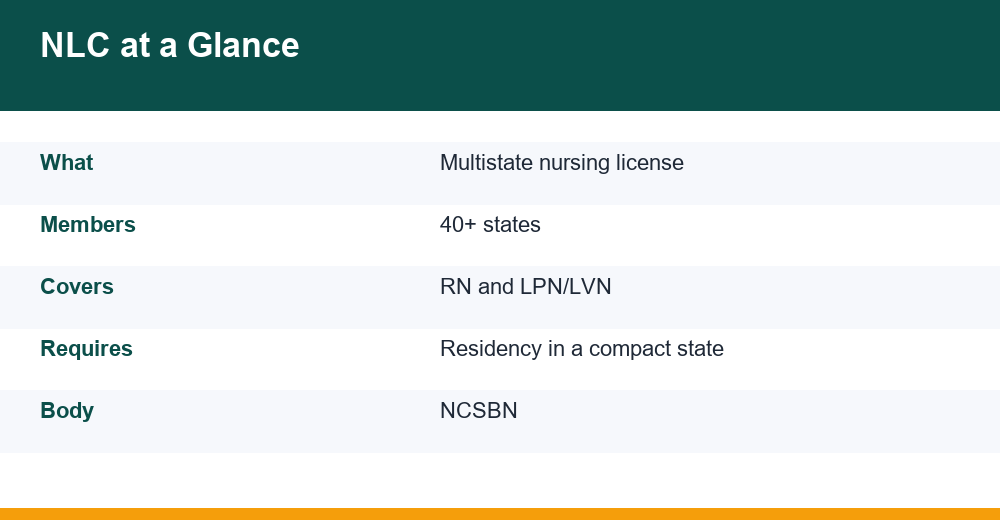
The compact is an agreement among participating states, coordinated by the NCSBN, that recognises a single “multistate” nursing license across all member states. Instead of applying for a separate license in every state where you want to work, a nurse who qualifies holds one multistate license issued by their home state and can practise in any other compact state. The current enhanced compact (the eNLC) added uniform licensure requirements, including a criminal background check, to strengthen public protection.
The multistate license
A multistate license is the core benefit. It authorises practice — both physical and via telehealth — in your home state and every other compact state, subject to each state’s practice laws. This is distinct from a single-state license, which is valid only in the state that issued it. Over 40 states participate in the compact, and the number has grown over time, though some large states remain outside it, so you should always check whether both your home state and your destination state are members.
Who is eligible
To hold a multistate license, your primary state of residence must be a compact member state, and you must meet the uniform licensure requirements. These include graduating from an approved nursing program, passing the NCLEX, holding an active unencumbered license, submitting to a criminal background check, and having no state or federal felony convictions that would disqualify you. If your home state is not a compact member, you cannot obtain a multistate license even if you want to work in compact states — you would apply for single-state licenses instead.
Telehealth & travel nursing
The compact is especially valuable for two growing areas of nursing. For telehealth, a multistate license lets a nurse care for patients located in other compact states without obtaining separate licenses, which is increasingly important as remote care expands. For travel nursing, it removes the delay and cost of licensing in each new assignment state, provided the assignment is in a compact state. Both make a multistate license a career asset well beyond passing the exam.
How to get a multistate license
If you already hold a license in a compact state that is your primary residence, you may apply to convert it to a multistate license through your board of nursing, meeting the uniform requirements. If you are newly licensed, you apply for the multistate license from your home compact state after passing the NCLEX — see our guides on how to register for the NCLEX and what the NCLEX is. Verify the current member states and requirements on the NCSBN website, which maintains the authoritative compact map.
Key takeaways
The Nurse Licensure Compact lets eligible nurses practise across 40-plus states — in person and via telehealth — on one multistate license, provided their home state is a member and they meet the uniform requirements. It is a major convenience for telehealth and travel nursing. Confirm your home and destination states’ membership before relying on it, and always verify current rules with your board of nursing and the NCSBN.
Frequently Asked Questions
What is the Nurse Licensure Compact?
The NLC is an agreement among member states that lets a nurse hold one multistate license and practise, in person and via telehealth, in all other compact states without extra licenses.
Who is eligible for a multistate license?
Nurses whose primary state of residence is a compact member state and who meet the uniform licensure requirements can obtain a multistate license from their home state.
Does the compact cover LPNs?
Yes. The compact covers both registered nurses (RNs) and licensed practical/vocational nurses (LPNs/LVNs).
Can I use a multistate license for telehealth?
Yes. A multistate license allows practice across compact states including telehealth, which is a major advantage for remote and travel nursing.