If you are starting nursing school or preparing to graduate, one of the first questions you will ask is: what is the NCLEX, and how does it decide whether you can practise as a nurse? This complete guide answers exactly that — what the NCLEX is, who runs it, how the computer-adaptive format and scoring work, and how to register — in plain English. Everything here is free information; this site sells nothing and no one can sell you a license.
Table of Contents
What the NCLEX is
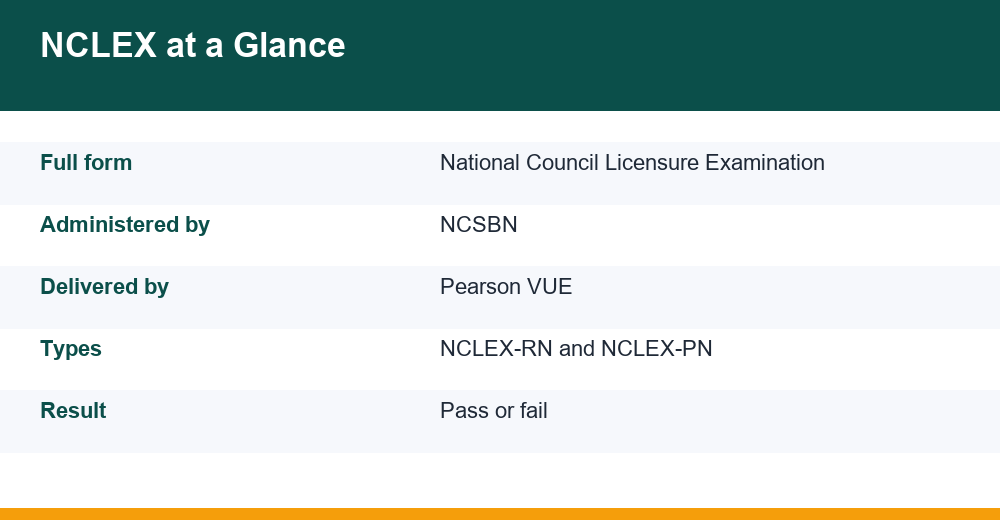
The NCLEX, or National Council Licensure Examination, is the standardized examination that nursing graduates must pass to become licensed to practise. There are two versions: the NCLEX-RN for registered nurses and the NCLEX-PN for practical or vocational nurses (LPN/LVN). Passing the NCLEX is the final academic hurdle between finishing an approved nursing program and being licensed by a board of nursing. The exam is used in the United States and Canada, and has also been adopted in Australia and New Zealand, which is why it is often described as the global standard for entry-level nursing competence.
The purpose of the NCLEX is to protect the public by ensuring that every new nurse can practise safely and effectively. Rather than testing whether you can memorise facts, it tests clinical judgement — whether you can apply nursing knowledge to real patient situations, set priorities, and make safe decisions. That focus on judgement, not recall, is the single most important thing to understand about the exam.
Who administers the NCLEX
The NCLEX is developed and owned by the National Council of State Boards of Nursing (NCSBN), the body that represents the nursing regulatory authorities across US states and territories. The exam itself is delivered at secure testing centres run by Pearson VUE, the NCSBN’s testing partner. Your individual eligibility to sit the exam, however, is granted by your state board of nursing (or the relevant nursing regulatory body), which is why registration involves both the board and Pearson VUE. You can read authoritative details on the official NCSBN website.
Format and length
The NCLEX is a Computer Adaptive Test (CAT). This means the computer selects each question based on how you answered the previous one: answer correctly and the next question is slightly harder; answer incorrectly and it is slightly easier. In this way the exam continually estimates your ability and homes in on whether you are above or below the passing standard. Because of this design, no two candidates get the same set of questions, and you cannot go back to change a previous answer.
Since 2023, both the NCLEX-RN and NCLEX-PN have a variable length of 85 to 150 questions, of which a small number are unscored pretest items being trialled for future exams. The maximum testing time is five hours, including the tutorial and breaks. The exam ends as soon as the computer can determine your result with confidence, so some candidates finish at 85 questions and others continue to the maximum — and finishing early is neither good news nor bad news in itself.
The Next Generation NCLEX (NGN)
In April 2023 the NCSBN launched the Next Generation NCLEX (NGN), the biggest change to the exam in years. The NGN adds new item types designed to measure clinical judgement more directly, including unfolding case studies, extended multiple-response questions, matrix/grid items, and the distinctive “bow-tie” and “trend” items. These formats present realistic patient scenarios and ask you to recognise cues, analyse information, prioritise, and evaluate outcomes. The traditional multiple-choice questions remain, but the NGN items reward candidates who genuinely think like a nurse rather than those who simply memorise.
How the NCLEX is scored
The NCLEX is not scored on a percentage or a number. The only result is pass or fail. The computer uses adaptive logic to decide, applying three rules. The 95% Confidence Interval Rule stops the exam once it is 95% certain your ability is clearly above or below the passing standard. The Maximum-Length Rule applies if you reach the last question without that certainty, in which case your final ability estimate decides the result. The Run-Out-Of-Time (ROOT) Rule applies if time expires early, using your recent performance. Because of this, the number of questions you answered tells you very little — candidates pass and fail at both 85 questions and 150 questions.
How to register for the NCLEX
Registering for the NCLEX involves two organisations and a clear sequence of steps:
- Apply for licensure with the board of nursing in the state where you want to be licensed.
- Register and pay the fee (currently US$200) to Pearson VUE.
- Wait for eligibility to be confirmed by the board of nursing.
- Receive your Authorization to Test (ATT) email, which contains your testing window.
- Schedule your exam at a Pearson VUE test centre and sit the NCLEX within the ATT validity period.
Miss the ATT window and you must re-register and pay again, so schedule promptly. For the current fee and process, always check the official NCSBN and Pearson VUE pages, since details can change.
Getting started the right way
Now that you know what the NCLEX is, the next step is a realistic preparation plan and an understanding of the question types — not shortcuts. Be very wary of anyone claiming to sell an NCLEX “certificate”, answers, or a nursing license: these offers are fraudulent, and a license obtained that way is not valid and can end a career before it starts. A genuine license is always earned by passing the exam and can be checked through official verification, which we explain in our guide on how to verify a nursing license. To begin preparing properly, see our NCLEX study plan and read the important information on our disclaimer page.
The NCLEX is challenging, but it is passable with honest, structured preparation. Understanding the format and scoring, as you now do, is the foundation everything else builds on.
Frequently Asked Questions
What is the NCLEX exam?
The NCLEX (National Council Licensure Examination) is the standardized exam that a nursing graduate must pass to obtain a license to practise as a nurse in the United States, Canada and Australia. It is administered by the NCSBN.
Is the NCLEX pass or fail?
Yes. The NCLEX does not give a numeric score; the result is simply pass or fail, based on whether the computer-adaptive exam determines you are above the passing standard.
How long is the NCLEX?
Since 2023 the exam has a variable length of 85 to 150 questions, with a maximum testing time of five hours including breaks. The computer stops once it can determine pass or fail with confidence.
Can you buy an NCLEX certificate or nursing license?
No. A nursing license can only be earned by passing the official NCLEX and meeting your board of nursing requirements. Anyone offering to sell a certificate or license is committing fraud.