A nursing license by endorsement lets a nurse who already holds an active RN or LPN/VN license in one US state get licensed in another state without sitting the NCLEX again. The new board checks your existing license, your exam history and your background, then issues its own license. Here is how the process works, what slows it down, and when a multistate compact license means you can skip it altogether.
Table of Contents
What Is a Nursing License by Endorsement?
Every US state and territory licenses nurses separately. Passing the NCLEX gets you licensed by examination in one jurisdiction. If you later want to practice somewhere else, you apply to the new board for a nursing license by endorsement, sometimes loosely called reciprocity or a license transfer.
The word “transfer” is a little misleading. Your original license does not move. The new board issues a separate license, and you decide whether to keep the old one active, let it lapse, or place it on inactive status where that option exists. Many travel nurses hold several single-state licenses at once.
Endorsement exists for RNs and for LPNs/LVNs. Advanced practice registered nurses usually need endorsement of the underlying RN license plus a separate APRN application, which follows its own rules in each state.
Who usually qualifies
- You hold an active, unencumbered license in another US jurisdiction (no current discipline or restrictions).
- You passed the NCLEX (or, for nurses licensed long ago, an exam the board accepts as equivalent).
- You completed a nursing program that meets the new state’s education standards.
- You can pass a criminal background check, usually with fingerprints.
- Some states add their own items, such as a jurisprudence exam, specific continuing education, or recent practice hours.
Internationally educated nurses face extra steps in many states, including credential evaluations and English proficiency evidence, even if they already hold a US license elsewhere. Check the destination board’s guidance for internationally educated applicants if that applies to you.
Do You Have to Retake the NCLEX to Move States?
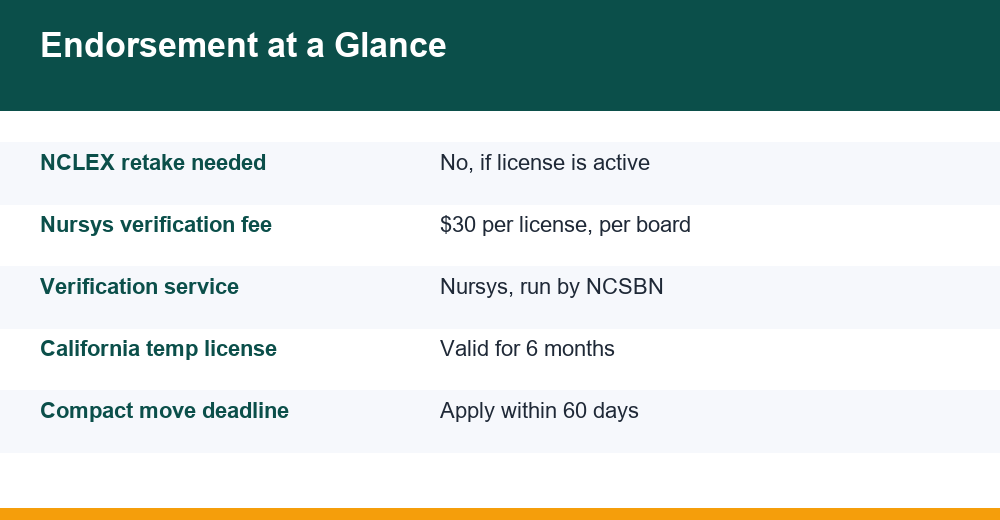
In most cases, no. The NCLEX is a national exam, so a pass in one state is recognized by every other US board. Endorsement exists precisely so that licensed nurses do not have to retest when they relocate.
There are exceptions worth knowing about:
- Lapsed or expired licenses: if you have not practiced for years and your license expired, the new board may require a refresher course or reentry program before it will endorse you.
- Never passed the NCLEX: nurses who were licensed under an older or foreign exam may be asked to sit the NCLEX if the board does not accept their original exam.
- Changing license level: an LPN who wants to work as an RN must pass the NCLEX-RN. Endorsement only covers the level you already hold.
If you do need to test, review the current 2026 NCLEX test plan before you schedule, because content weighting and item types have shifted since many experienced nurses last sat the exam.
How to Transfer Your Nursing License: 6 Steps
The exact forms differ by board, but nearly every application for a nursing license by endorsement follows the same sequence. Doing the steps in this order avoids the most common hold-ups.
- Check whether you need endorsement at all. If you hold a multistate compact license and are moving to another compact state, the rules are different (see the compact section below).
- Read the destination board’s endorsement page. Note its fee, fingerprint method, any jurisdiction exam, and whether it accepts Nursys verification.
- Submit the online application and pay the fee. Most boards use an online portal. Answer every disclosure question honestly; undisclosed history found later causes far longer delays than disclosed history.
- Send license verification. Use Nursys for participating boards, or request verification directly from boards that do not participate.
- Complete fingerprints and the background check. Follow the destination board’s instructions exactly, including which vendor or card type to use.
- Apply for a temporary permit if offered, then track your file. Watch your email and portal for deficiency notices and respond quickly.
Before you start, it helps to confirm that your current license record looks correct in the national database. Our guide on how to verify a nursing license walks through checking your own status, expiration date and any listed discipline.
Documents to have ready
- Government-issued photo ID and Social Security number
- License numbers and issuing states for every nursing license you have ever held
- Nursing program name, graduation date, and degree
- Court records and explanation letters for any criminal history or past discipline
- Proof of residency, if you are applying for a multistate license
Nursys Verification: Cost and How It Works
Nursys is the national nurse licensure database run by the National Council of State Boards of Nursing (NCSBN). Its Nurse License Verification service sends your license data electronically from your current board to the board where you are applying.
You order it through Nursys. The fee is $30 per license type, per board of nursing you are applying to, paid by card, and the verification is made available to the boards you select once the order is processed.
| Situation | What to do |
|---|---|
| Your original board participates in Nursys | Order Nurse License Verification on nursys.com |
| Your original board does not participate | Contact that board directly for written verification |
| You hold an RN and an LPN license | Pay separately for each license type you need verified |
| You are applying to two states at once | Pay once per destination board |
| Newly licensed in the last few days | Wait for your board to upload your record |
Two points trip people up. First, the free QuickConfirm report is a lookup tool, not a verification for licensure, so boards will not accept it for endorsement. Second, Nursys verification covers RN and LPN/VN licenses; APRN and other credentials may need direct verification from the issuing board.
How Long Does Endorsement Take?
Processing times vary widely between states and between applicants. A clean application in a fast state can be done in a few weeks. A file with a criminal history question, a non-participating verification board, or slow fingerprints can take several months.
Boards that publish targets usually start the clock only once your file is complete. Time spent waiting on fingerprints or verification is often not included, so read any published target with that in mind.
| Stage | Typical range (approximate) | What controls it |
|---|---|---|
| Online application submitted | Same day | You |
| Nursys verification received | Same day to a few days | Your original board’s Nursys participation |
| Fingerprint results returned | Days for electronic prints; weeks for ink cards | Fingerprint method and state/FBI backlogs |
| Board review of complete file | Days to several weeks | Board staffing and season |
| Review of flagged history | Often months | Board legal or investigations staff |
The spread between boards is real. Some publish a target number of business days for complete applications; others, such as the California Board of Registered Nursing, publish current processing times and note that delays at the state Department of Justice or the FBI are outside the board’s control. Always check the destination board’s own page rather than relying on averages from forums.
Graduation season (roughly May through August) is a busy period for many boards, because new graduate exam applications arrive at the same time. If you can, submit your endorsement application two to three months before your planned start date.
Working on a Temporary Permit While You Wait
Many states offer a temporary license or permit for endorsement applicants. It lets you start working legally while the board finishes processing the permanent license. Not every state offers one, and those that do set their own conditions and lengths.
| Board | Temporary license length | Key condition |
|---|---|---|
| California BRN | 6 months | Fingerprint results from state DOJ and FBI must be received first |
| States that offer permits | Set by each board | Usually requested with or after the endorsement application |
| States without permits | Not available | You wait for the permanent license |
In California, for example, you can request the temporary license with your endorsement application or any time before the permanent license is issued. Fingerprint results must be in before it is granted, and Live Scan is only available at locations inside the state, so out-of-state applicants often use ink cards and wait longer.
A temporary permit is usually non-renewable and tied to a single state. If the permanent license is denied, the permit ends. Employers will typically check the temporary license on the board’s lookup before your first shift, so keep the confirmation handy.
Do You Need Endorsement With a Compact License?
The Nurse Licensure Compact (NLC) lets nurses whose primary state of residence is a compact state hold one multistate license that allows practice in every other compact state. More than 40 jurisdictions have enacted the NLC, though a few are still phasing in implementation, so check the current map before relying on it. Our Nurse Licensure Compact guide explains how it works in more detail.
Whether you need a new license depends on where you live and where you are going:
| Your move | Endorsement needed? |
|---|---|
| Live in a compact state, take a job or travel assignment in another compact state | No, your multistate license covers it |
| Permanently move from one compact state to another | Yes, apply for a multistate license in the new home state within 60 days |
| Move to or work in a non-compact state (such as California or New York) | Yes, apply for that state’s single-state license |
| Move from a non-compact state to a compact state | Yes, and you may qualify for a multistate license there |
The 60-day residency rule
Under NLC rules, a multistate licensee who permanently changes their primary state of residence to another compact state must apply for a license in the new home state within 60 days of the move. The trigger is actually relocating with the intent to live there, not a short-term assignment.
If you apply on time, you can keep practicing on your existing multistate license while the new state processes your nursing license by endorsement. Missing the deadline is treated as a rule violation. Travel assignments and temporary postings do not change your primary state of residence.
Moving to a non-compact state works differently. Notify your former board of your new address; your multistate license is converted to a single-state license for that former home state, and you apply for endorsement in the new state as normal.
Common Delays and How to Avoid Them
Most slow applications share the same handful of causes. Nearly all of them are avoidable with a little preparation.
- Incomplete disclosure: leaving out an old arrest, DUI or out-of-state discipline almost always surfaces in the background check. Disclose it, and attach court records and a short explanation.
- Wrong fingerprint method: using the wrong card type or vendor can mean starting over. Follow the board’s instructions exactly.
- Rejected ink cards: smudged prints are a frequent cause of resubmission. Use a professional fingerprinting service.
- Ordering QuickConfirm instead of verification: the board will not accept it.
- Missing jurisdiction requirements: some states require a jurisprudence exam or specific coursework. Complete these while you wait on other items.
- Ignored deficiency emails: boards often pause a file until you respond. Check your portal and spam folder weekly.
Keep a simple log with the date you submitted each item, the receipt or confirmation number, and any board contact. If your file stalls beyond the board’s published target, that log makes a status inquiry quick and specific.
Finally, do not resign from your current job or commit to a start date you cannot move until you have either a temporary permit or a permanent license in hand. A nursing license by endorsement is routine for most applicants, but timing is the one thing you do not fully control.
Frequently Asked Questions
How do I transfer my nursing license to another state?
You apply to the new state’s board of nursing for licensure by endorsement. That usually means an online application and fee, license verification through Nursys or directly from your original board, fingerprints for a background check, and any state-specific extras such as a jurisprudence exam. The new board then issues its own license; your original license is not moved.
How long does nursing license endorsement take?
It ranges from a few weeks to several months. A complete, clean file in a fast state can clear quickly, while applications that need a criminal history review often take months. Fingerprint turnaround, whether your original board uses Nursys, and seasonal backlogs are the biggest factors. Apply two to three months ahead of your start date if possible.
Can I work on a temporary permit while endorsement is pending?
Often, yes. Many states issue temporary licenses to endorsement applicants; California’s lasts six months and is granted only after fingerprint results clear. Some states do not offer them at all. A temporary permit is usually non-renewable, applies only in that state, and ends if the permanent license is denied.
Do I need endorsement if I have a compact license?
Not for working in other compact states while you keep the same home state. You do need to apply if you permanently move to another compact state (within 60 days under NLC rules) or if you want to practice in a non-compact state, which requires its own single-state license.