Few things cause more anxiety than not understanding NCLEX scoring — especially the moment the screen goes blank and the exam ends. This guide explains NCLEX scoring in plain English: how the computer-adaptive test works, why there is no percentage score, and the three rules that decide pass or fail. Understanding this removes a huge amount of exam-day worry, because you will know that what feels like a bad sign often is not.
Table of Contents
The computer-adaptive test (CAT)
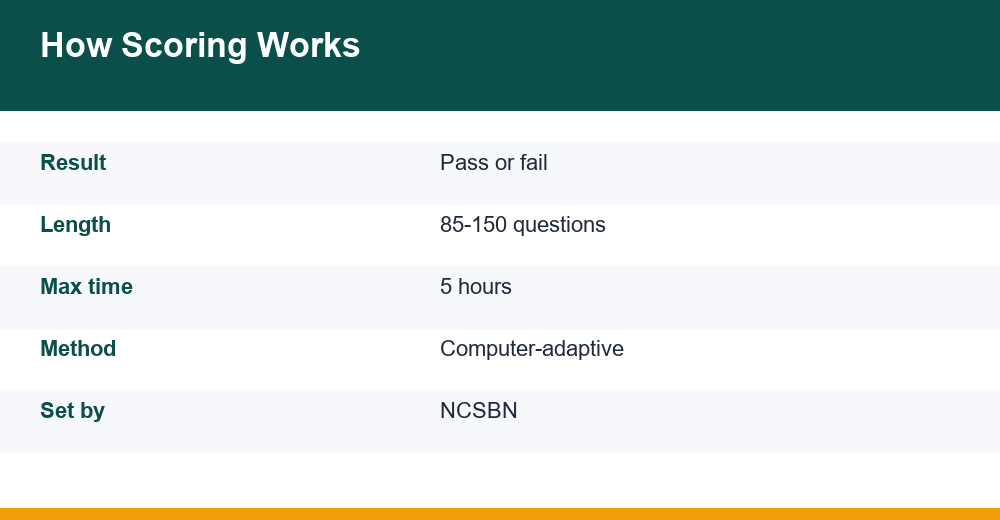
The NCLEX is a Computer Adaptive Test. Every time you answer a question, the computer re-estimates your ability and selects the next question accordingly: answer correctly and the next question is slightly harder; answer incorrectly and it is slightly easier. Over the course of the exam this zeroes in on your true ability level. Because the test adapts to you, no two candidates see the same questions, and you cannot skip a question or go back to change an answer.
Pass or fail, not a score
The NCLEX does not produce a percentage or a number. The only outcome is pass or fail. The computer is not counting how many questions you got right; it is estimating whether your ability is above or below a fixed passing standard. This is why comparing “how many I got right” with a friend is meaningless — the exam is measuring ability, not tallying a score. Around half of the questions you face will be near your ability level, which is by design and does not indicate you are doing badly.
The three scoring rules
The exam ends according to one of three rules:
- 95% Confidence Interval Rule — the exam stops as soon as the computer is 95% certain your ability is clearly above (pass) or clearly below (fail) the passing standard. This ends most exams.
- Maximum-Length Exam Rule — if you reach the maximum number of questions without that certainty, your final ability estimate decides the result: above the standard passes, below it fails.
- Run-Out-Of-Time (ROOT) Rule — if time runs out before either of the above, the result is based on your ability estimate from the questions you did answer, provided you answered a minimum number.
What exam length means (and does not)
Since 2023 the exam ranges from 85 to 150 questions. It is natural to read meaning into when the exam stops, but the length alone tells you almost nothing. The exam ends when the computer is confident of your result — and it can become confident that you have passed, or that you have failed, at any point. Candidates pass at 85 questions and fail at 85 questions; others pass at 150 and others fail at 150. Do not try to interpret your result from the number of questions; it is not a reliable signal.
The passing standard
The passing standard is set by the NCSBN based on the level of ability required to practise safely as an entry-level nurse. It is reviewed periodically and expressed on a measurement scale (in logits) rather than as a percentage. Because the standard reflects safe practice rather than a fixed number of correct answers, the exam is fundamentally a judgement of competence. You do not need to be perfect; you need to demonstrate ability above the safe-practice threshold.
Common scoring myths
Two myths deserve correcting. The first is that “the screen shutting off early means I failed” — false; early shut-off simply means the computer reached confidence, which happens for passes too. The second is that “harder questions mean I am doing well” or “easier questions mean I am failing” — also unreliable, because the adaptive engine constantly adjusts and your perception of difficulty is a poor guide. The healthiest exam-day mindset is to answer each question as well as you can and ignore the pattern entirely.
Key takeaways
NCLEX scoring is pass/fail, driven by a computer-adaptive engine and three stopping rules, against a safe-practice standard — not a percentage and not a question count. Knowing this lets you walk in calm and focus on one question at a time. Pair this understanding with solid preparation using our NCLEX study plan and, if the result does not go your way, our guide on retaking the NCLEX. The authoritative source is the NCSBN website.
Frequently Asked Questions
How is the NCLEX scored?
The NCLEX is a computer-adaptive test scored pass or fail. It adjusts question difficulty to your ability and stops once it can determine, with confidence, whether you are above or below the passing standard.
Is there a passing percentage on the NCLEX?
No. There is no percentage or numeric score. You either demonstrate ability above the passing standard (pass) or you do not (fail).
Does finishing at 85 questions mean I passed?
Not necessarily. Candidates pass and fail at both 85 and 150 questions. The number of questions alone tells you nothing about your result.
What are the three NCLEX scoring rules?
The 95% Confidence Interval Rule, the Maximum-Length Exam Rule, and the Run-Out-Of-Time (ROOT) Rule — these determine when the exam stops and how the result is decided.