
The NCLEX pass rate is among the most searched — and most misunderstood — nursing exam statistics. This guide explains it in plain terms: what the numbers mean, how first-time and repeat rates differ, why they vary, and the crucial fact that the exam is measured against a fixed standard, not a curve. Understanding this helps you interpret the statistics correctly and, more importantly, keeps your focus where it belongs — on your own preparation.
Table of Contents
NCLEX pass rate: what it means
The NCLEX pass rate is simply the percentage of candidates who pass the exam, published regularly by the NCSBN. It is reported in categories — for example first-time versus repeat takers, and US-educated versus internationally educated candidates — because these groups perform quite differently. When you see a single headline figure, it is worth asking which group it describes, because the differences between groups are large.
First-time vs repeat takers
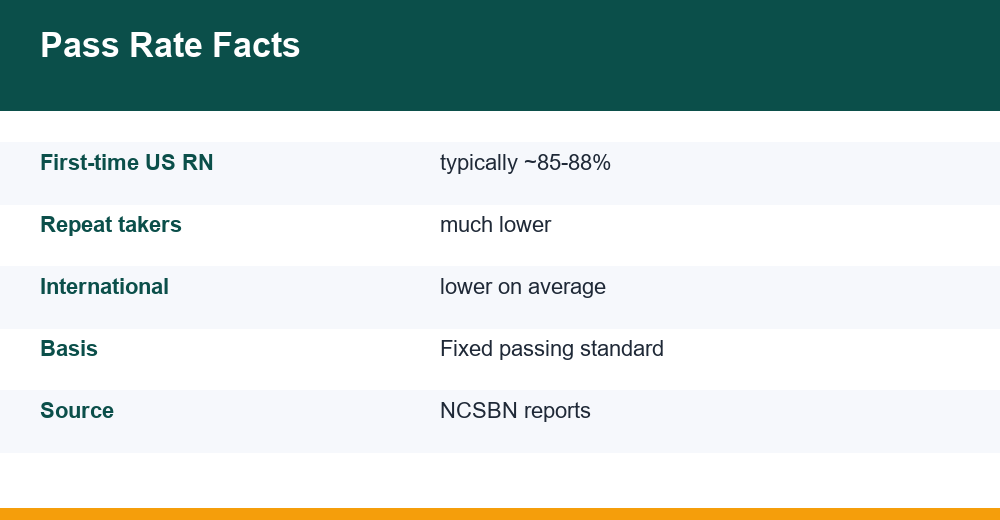
The most quoted figure is the first-time, US-educated RN pass rate, which in recent years has typically sat in the mid-to-high 80s percent. Repeat takers — those sitting the exam again after a previous fail — pass at substantially lower rates, and internationally educated candidates also pass at lower rates on average, partly because of unfamiliarity with US-specific practice. These differences are why a blended “overall” pass rate can be misleading if you do not know the mix behind it.
Why pass rates vary
Several factors drive the variation. First-time US graduates test soon after finishing an approved program, so their knowledge is fresh. Repeat takers, by definition, have already found the exam difficult once. Internationally educated nurses face additional hurdles such as different training and terminology. Pass rates can also shift year to year when the passing standard is reviewed or when the exam changes — as it did with the move to the Next Generation NCLEX. None of this changes what you must do; it simply explains the numbers.
The NCLEX is not graded on a curve
This is the single most important thing to understand: the NCLEX is not graded on a curve. Your result does not depend on how other candidates performed on the day. Instead, the exam measures whether your ability is above a fixed passing standard for safe entry-level practice, as our scoring guide explains. That means everyone who meets the standard passes — you are not competing against other test-takers for a limited number of passes. The pass rate is a description of outcomes, not a quota.
How to use this information
Use pass-rate statistics wisely. A nursing program’s pass rate is a reasonable indicator of how well it prepares students, so it can inform your choice of program. But once you are the one testing, the overall figure is irrelevant to your result — what matters is whether you meet the standard. So treat the encouraging first-time pass rate as motivation, not complacency, and put your energy into preparation using a plan like our NCLEX study plan. If you have to retake, our retake guide shows how to improve your odds.
Key takeaways
The pass rate is high for first-time US graduates and lower for repeat and international takers, and it is a description of outcomes against a fixed safe-practice standard — not a curve you compete on. Interpret headline figures by asking which group they describe, use program pass rates to inform your choices, and then focus entirely on your own preparation, which is the only thing that determines your result. Official statistics are published on the NCSBN website.
Frequently Asked Questions
What is the NCLEX pass rate?
The pass rate is the percentage of candidates who pass. First-time US-educated RN candidates typically pass at around 85-88%, while repeat takers and internationally educated candidates pass at lower rates. The NCSBN publishes official figures.
Is the NCLEX graded on a curve?
No. The NCLEX is measured against a fixed passing standard of safe practice, not a curve. Your result does not depend on how other candidates performed.
Why do first-time takers pass at higher rates?
First-time, US-educated candidates test soon after finishing an approved program while their knowledge is fresh, which contributes to higher first-attempt pass rates than repeat takers.
Does a high program pass rate matter?
A nursing program’s NCLEX pass rate is one useful indicator of how well it prepares students, but individual preparation still determines your own result.