
Failing the NCLEX is discouraging, but it is not the end — many excellent nurses passed on a second attempt, and retaking the NCLEX with the right approach dramatically improves your odds. This guide covers the retake rules and waiting period, how to use your Candidate Performance Report to study smarter, and how to build a stronger plan and mindset for your next attempt. A first fail usually reflects a preparation gap, not a lack of ability — and gaps can be closed.
Table of Contents
First, breathe
A failed attempt feels personal, but it is a common experience and a solvable problem. The candidates who pass on a retake are almost always the ones who treat the result as information rather than a verdict — they analyse what went wrong, adjust their approach, and prepare more effectively. Give yourself a short reset, then channel the disappointment into a concrete plan. The steps below turn a fail into a clear roadmap for passing.
Retake rules and the waiting period
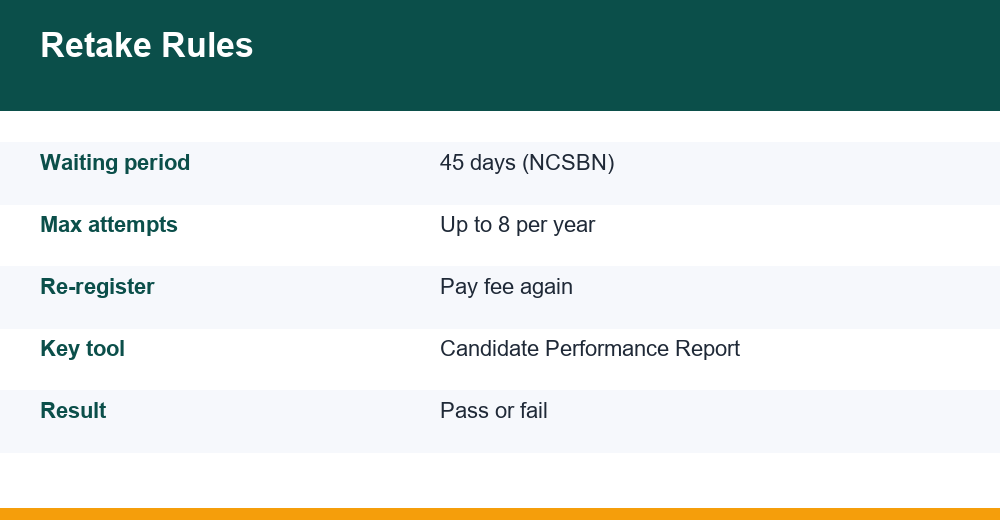
Under the NCSBN retake policy, you must wait a minimum of 45 days between attempts, and you may test up to eight times per year. Your board of nursing, however, can set stricter limits — some cap the number of attempts or require remediation after multiple fails — so check your board’s rules alongside the national policy. Retaking also means re-registering with Pearson VUE and paying the exam fee again, and re-confirming eligibility with your board, so build those steps and costs into your timeline.
Use your Candidate Performance Report
Every candidate who fails receives a Candidate Performance Report (CPR), and it is the single most valuable tool for your retake. The CPR shows, for each content area of the test plan, whether you performed above, near or below the passing standard. This tells you exactly where to focus: the areas marked “below” are your priorities, while “above” areas need only maintenance. Building your retake study plan directly from the CPR is far more efficient than starting over from scratch, because it targets the specific gaps that caused the fail.
Why candidates fail the first time
Understanding common failure causes helps you avoid repeating them. Frequent reasons include relying on content review while doing too few practice questions, not reviewing the rationale for every answer, weak time management on a long exam, under-preparing for the Next Generation item types, and test anxiety that undermined otherwise adequate knowledge. Many candidates also underestimate the exam’s emphasis on clinical judgement, studying to recall facts rather than to make decisions. Our guide on why candidates fail the NCLEX explores these in depth.
Retaking the NCLEX: a stronger plan
Rebuild your preparation around three principles. First, lead with practice questions and review the rationale for every one, correct or not — this builds the judgement the exam tests. Second, prioritise your CPR weak areas, giving them the most time while keeping strong areas warm. Third, simulate the real exam with full-length, timed practice tests to build stamina and calibrate your readiness. A focused four-to-six week retake plan built this way is usually more effective than the longer, less targeted study that preceded the first attempt. Our NCLEX study plan gives a ready framework you can adapt.
Mindset for the retake
Confidence built on genuine preparation is the antidote to the anxiety that derails many retakes. Do not sit the exam again until your practice-test performance is consistently at or above your question bank’s passing benchmark and your CPR weak areas have clearly improved. On the day, remember what you now know about NCLEX scoring — that early shut-off and question difficulty are not signals — and answer one question at a time. Preparation plus a calm, informed mindset is what turns a retake into a pass.
Key takeaways
Retaking the NCLEX is a well-trodden path to becoming a nurse. Wait the required 45 days, mine your Candidate Performance Report for your weak areas, rebuild a question-led study plan, and address any time-management or anxiety issues from the first attempt. Confirm retake rules with your board of nursing and the official NCSBN website. With targeted effort, a first fail becomes a second-attempt success far more often than most candidates expect.
Frequently Asked Questions
How soon can I retake the NCLEX?
Under the NCSBN retake policy you must wait at least 45 days between attempts. Your board of nursing may set additional limits, so confirm its rules too.
How many times can you take the NCLEX?
The NCSBN allows up to eight attempts per year, subject to the 45-day gap between attempts, but individual boards of nursing may impose stricter limits.
What is the Candidate Performance Report?
The Candidate Performance Report (CPR) is a document given to candidates who fail. It shows how you performed in each content area, helping you target your weak spots for the retake.
Do I have to pay to retake the NCLEX?
Yes. Retaking the NCLEX requires re-registering with Pearson VUE and paying the exam fee again, and re-establishing eligibility with your board of nursing.