
If you are choosing a nursing path or preparing to test, understanding NCLEX RN vs PN is essential, because the two exams lead to different roles, scopes of practice and career trajectories. This guide explains the key differences between the NCLEX-RN and NCLEX-PN — in the roles they license, the content they emphasise, and the format they share — so you know exactly what you are preparing for.
Table of Contents
NCLEX RN vs PN: the basics
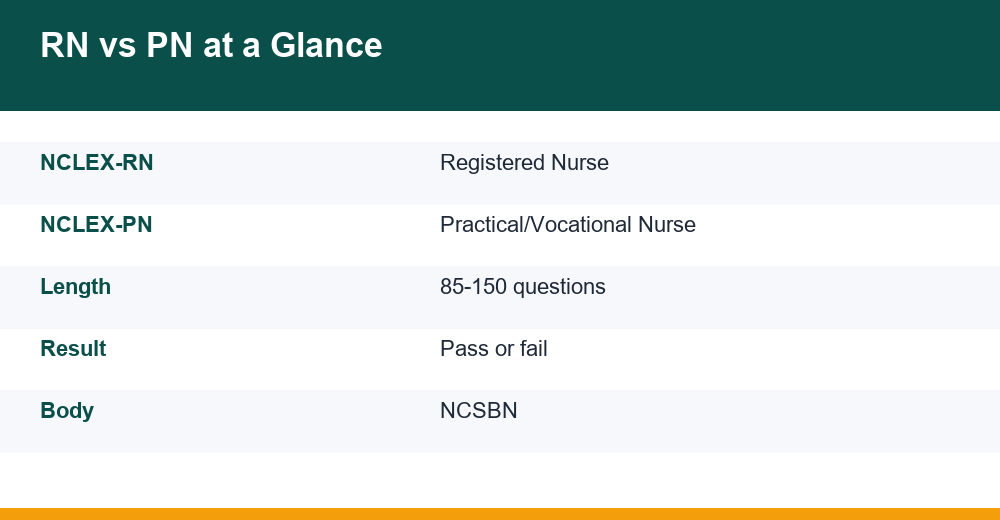
Both exams are created by the NCSBN and share the same purpose: to confirm that a candidate can practise safely at their level. The difference lies in the level. The NCLEX-RN licenses registered nurses, who plan and coordinate patient care, perform complex assessments, and often supervise other staff. The NCLEX-PN licenses practical or vocational nurses (LPNs in most states, LVNs in California and Texas), who provide direct patient care and collect data, frequently under the direction of a registered nurse or physician. In short, RN is a broader, more independent role, and the exam reflects that.
The roles they lead to
The scope of practice is the real driver of the differences between the exams. A registered nurse typically carries out full nursing assessments, develops and evaluates care plans, administers a wide range of treatments and medications, educates patients and families, and delegates tasks to other members of the care team. A practical/vocational nurse contributes to that care — taking vital signs, monitoring patients, providing basic bedside care, and reinforcing teaching — usually within a more defined scope and under supervision. Because the RN role involves more independent judgement and coordination, the NCLEX-RN tests those abilities more heavily.
Content and focus
Both exams are organised around the same broad framework of “Client Needs” categories — areas such as Safe and Effective Care Environment, Health Promotion and Maintenance, Psychosocial Integrity, and Physiological Integrity. The difference is in emphasis. The NCLEX-RN gives more weight to management of care, care planning, and complex physiological adaptation, reflecting the RN’s coordinating role. The NCLEX-PN emphasises the coordinated care the PN contributes and the safe delivery of established care. So while the topics overlap, the depth and the decision-making level expected differ.
| Aspect | NCLEX-RN | NCLEX-PN |
|---|---|---|
| Licenses | Registered Nurse | Practical/Vocational Nurse |
| Core focus | Independent judgement, care planning, management | Providing care, data collection, coordinated care |
| Scope | Broader, more independent | More defined, often supervised |
| Emphasis | Management of care | Coordinated care |
The format they share
Despite the differences in content, the two exams share an identical structure. Both are computer-adaptive tests of 85 to 150 questions with a maximum time of five hours, both include the Next Generation NCLEX item types that test clinical judgement, and both are scored simply as pass or fail. This means the study techniques and test-taking skills you build transfer well between them — useful for practical nurses who later bridge to the RN role. For a full explanation of the shared format, see our guide on what the NCLEX is.
Which exam is for you
The exam you take is determined by the nursing program you complete. A practical/vocational nursing program prepares you for the NCLEX-PN; an associate or bachelor’s degree in nursing prepares you for the NCLEX-RN. Many nurses begin as LPNs/LVNs to enter the profession sooner, then complete an LPN-to-RN bridge program and sit the NCLEX-RN later. Neither path is “better” — they suit different goals, timelines and circumstances, and both are respected, licensed roles. You can read more about the profession and its regulation on the official NCSBN website.
Key takeaways
The core of NCLEX RN vs PN is scope: the RN exam tests broader, more independent clinical judgement and management, while the PN exam focuses on delivering safe, coordinated care within a defined role. The format — adaptive, 85 to 150 questions, pass or fail, with Next Generation items — is the same for both. Whichever you are preparing for, the winning approach is honest, structured study of clinical judgement, not shortcuts. Begin with our NCLEX study plan to build a schedule that fits your exam.
Frequently Asked Questions
What is the difference between NCLEX-RN and NCLEX-PN?
The NCLEX-RN licenses registered nurses and emphasises independent clinical judgement, care planning and management; the NCLEX-PN licenses practical/vocational nurses and focuses more on providing care and collecting data within a defined scope, often under RN or physician direction.
Is the NCLEX-RN harder than the NCLEX-PN?
The NCLEX-RN covers a broader scope and places greater emphasis on independent decision-making, care coordination and management, so it is generally considered more demanding, though both exams are challenging.
Do NCLEX-RN and NCLEX-PN have the same format?
Yes. Both are computer-adaptive exams of 85 to 150 questions with a five-hour maximum, use the same Next Generation item types, and are scored pass or fail.
Can an LPN take the NCLEX-RN later?
Yes. Many practical nurses later complete an RN program (such as an LPN-to-RN bridge) and then sit the NCLEX-RN to become registered nurses.