
NCLEX time management is misunderstood more often than any other part of exam preparation, because candidates import habits from tests that do not resemble it. On a fixed-length paper, pacing means dividing the time by the questions and moving steadily. On a variable-length adaptive exam you do not know how many questions you will answer, there is no going back, and rushing produces exactly the wrong outcome. Running out of time is uncommon. Losing marks to hurried reading is not. These seven approaches address the pacing problem as it actually presents itself, which is one of attention rather than of speed.
Table of Contents
Why the adaptive format changes pacing
The exam selects each question based on how you have answered so far, aiming to sit near the boundary of your ability. The consequence is that the questions should feel difficult throughout, and that difficulty is not a signal you are failing.
Two structural facts follow. You cannot return to an earlier question, so there is no value in banking easy ones to revisit later. And the exam ends when it has enough information, which may be well before the maximum number of items.
What that means for the clock
Pacing cannot be calculated from a total, because there is no reliable total. The useful frame is a budget per question rather than a schedule across the paper, and the budget is generous enough that accuracy, not speed, is where the marks are.
NCLEX time management starts with a per-question budget
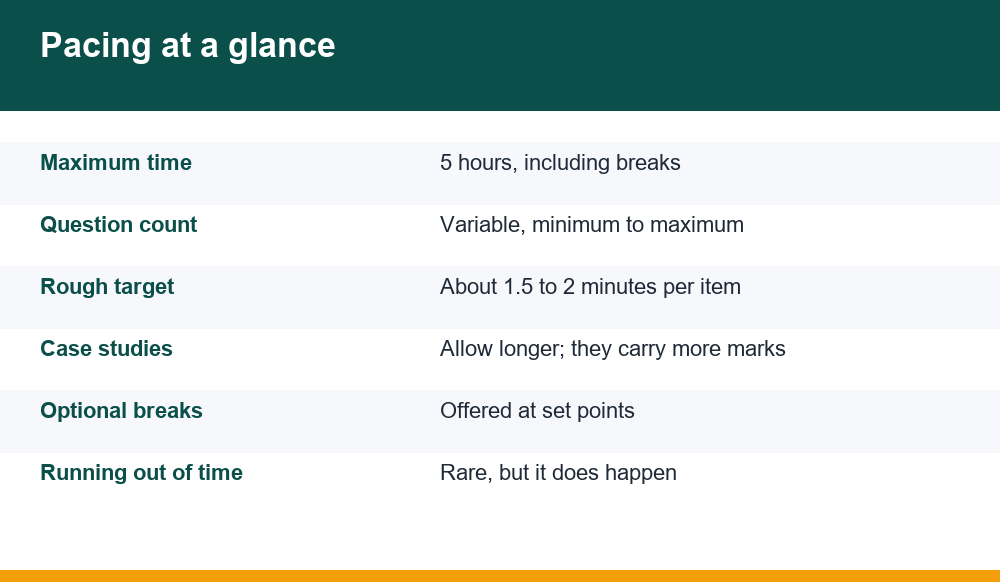
Across five hours, a rough working figure of a minute and a half to two minutes per item leaves considerable room, and most candidates finish comfortably inside the limit.
The point of knowing the number is not to hit it on every question. It is to recognise when you have gone badly past it, which is the only situation where the clock genuinely matters. A question that has taken five minutes is a question you are not going to resolve by spending a sixth.
Averages also work in your favour. Straightforward recall items take forty seconds, which banks time for the reasoning items that need three minutes. The budget is an average across the exam, not a limit on each question.
Read the stem before the options
The most common time loss in NCLEX time management is not slow reading; it is re-reading. Candidates scan the options first, then go back to the stem, then back to the options, covering the same text three times.
Read the question through once, properly, and decide what it is asking before looking at any answer. Where possible, form your own answer first and then find the option closest to it. This single habit is worth more time across an exam than any speed-reading technique.
- Identify the client, the condition and what is being asked
- Watch for words that invert the question: except, contraindicated, avoid
- Note priority wording: first, initial, most important, best
- Form your own answer before reading the options
- Read all options even when the first looks correct
The priority wording matters disproportionately, because several options are usually appropriate actions and only one is the appropriate first action. Missing that word turns a question you understood into a question you got wrong.
Give the hard ones a ceiling
Since you cannot return to a question, every item must be answered before moving on, which makes the decision about when to stop deliberating a real one.
Set a personal ceiling, around three minutes, and when a question reaches it, eliminate what you can, choose the best remaining option and move. The alternative is not eventually getting it right; it is spending six minutes and still guessing, while arriving at the next question tired.
The emotional residue is the real cost. A question agonised over tends to follow a candidate into the next two or three, and that carry-over does more damage than the single mark ever could.
Treat case studies differently
The Next Generation format introduced unfolding case studies, which present a scenario across several linked questions with information added as it progresses. They take longer by design and that is appropriate rather than a pacing failure.
The efficient approach is to read the scenario thoroughly once at the start rather than skimming and returning to it for each item. The time spent on that first careful read is recovered several times over across the linked questions.
Watch for new information appearing as the case unfolds. A vital sign or a laboratory value introduced partway through usually changes the correct answer, and candidates who answer later items from their memory of the opening scenario miss exactly that.
Use the breaks deliberately
Optional breaks are offered at set points and the clock continues to run during them, which leads many candidates to skip them entirely. That is usually a mistake.
Concentration degrades measurably after about ninety minutes of continuous testing, and the questions do not get easier as it does. Five minutes spent standing up, drinking water and looking at something other than a screen buys back more accuracy than those five minutes of testing would have produced.
| Situation | Take the break? |
|---|---|
| Past 90 minutes, still feeling sharp | Yes, before you stop feeling sharp |
| Re-reading the same line repeatedly | Yes, immediately |
| Anxious after a run of hard questions | Yes, and remember hard is expected |
| Under an hour in and settled | No, keep the momentum |
Eat something beforehand and keep it light. A heavy meal before a five-hour exam produces the dip in concentration people blame on the questions.
Stop checking the clock
Frequent clock-checking is itself a drain. Each glance interrupts reasoning and costs more than the information is worth, and in an exam where time is rarely the binding constraint the information is worth very little.
Check it at natural points: after the first twenty questions to confirm the pace is reasonable, and at each break. Otherwise leave it alone.
The same applies to counting questions. Candidates try to infer how they are doing from how many items have appeared, which is unreliable and uniformly destructive to concentration. The exam ending early and the exam running long are both consistent with passing.
Practise timed from the start
The most common preparation error is doing thousands of untimed questions and then meeting the clock for the first time on the day.
Untimed practice trains a different skill. It allows pauses, re-reading and looking things up mid-question, none of which is available in the exam, and it produces a score that flatters the candidate’s actual readiness.
Work in timed blocks from early on, in sets of twenty-five or more, with no interruptions and no reference material. The point is not the score but building the habit of sustained reasoning under a clock, which is the skill being tested alongside the content. Our cram sheet covers the content side for the final fortnight once that habit is in place.
If you are genuinely running out of time
It is uncommon and it does happen, usually to candidates who read very carefully and deliberate at length. If the clock becomes the binding constraint, the approach changes.
Shorten deliberation rather than reading. Cutting the reading is what produces errors; cutting the time spent choosing between two remaining options usually does not, because by that point additional thought rarely improves the choice.
Answer every question regardless. There is no penalty for a wrong answer beyond the mark itself, and an unanswered item cannot be scored at all. A reasoned guess on an exhausted budget is strictly better than leaving it.
Afterwards, whatever happened, resist reconstructing the exam from memory. Recall of individual questions is poor, the adaptive format means difficulty was expected throughout, and candidates routinely come out convinced they failed an exam they passed comfortably.
The day itself
Pacing on the day is affected by things decided well before the first question appears, and these are the ones candidates most often get wrong.
Arrive early enough that check-in is not rushed. The administrative process takes longer than people expect, involves identification and a palm scan, and starting the exam while still flustered costs more than the twenty minutes saved by leaving late.
Sleep matters more than a final night of revision, by a wide margin. Reading content at midnight before a five-hour reasoning exam trades the thing being tested for the thing that feels productive, and the exchange is a poor one.
- Eat beforehand, lightly rather than heavily
- Take identification exactly as the registration specifies
- Expect the testing room to be cold and dress for it
- Do not revise in the car park; it raises anxiety and changes nothing
- Plan what you will do afterwards, so the day has an ending
That last point sounds trivial and is not. Candidates who leave the centre with nowhere to be spend the afternoon reconstructing questions from memory, which is unreliable and uniformly distressing. Good NCLEX time management extends a little past the exam itself.
One further point on the weeks before. Candidates frequently increase question volume as the date approaches and reduce timed practice, which is precisely backwards. The content is largely fixed by then; what still improves is the ability to sustain careful reasoning for several hours, and that only develops under a clock.
A reasonable final fortnight looks like fewer questions done properly in timed blocks, one full-length simulation to confirm the stamina is there, and the last two days kept light. Candidates who do that consistently report the exam itself feeling familiar rather than alarming, which is most of what pacing is actually for.
And a note for anyone retaking. The pacing problem is usually different the second time, because anxiety arrives earlier and the temptation to over-deliberate on the opening questions is stronger. Setting the three-minute ceiling before you walk in, and deciding in advance to take the first break regardless of how it is going, addresses most of that.
Finally, treat the result as information about one sitting rather than about your capability as a nurse. Plenty of competent candidates need two attempts, and the adaptive format means the experience of the exam tells you very little about how it went either way.
Results timing varies by state board, and the unofficial result services are not the official answer however widely they are discussed.
Frequently Asked Questions
How much time should I spend per question?
Roughly a minute and a half to two minutes as an average across the exam, not a limit on each item. Recall questions take under a minute and bank time for reasoning items that need three. The figure matters mainly for recognising when you have gone far past it.
Should I take the optional breaks?
Usually yes, particularly past the ninety-minute mark. The clock continues running, but concentration degrades measurably after sustained testing and the accuracy recovered generally outweighs the minutes spent. Take one immediately if you notice yourself re-reading the same line.
Can I go back and change an answer?
No. Each question must be answered before moving on and cannot be revisited, which is why setting a personal ceiling of around three minutes matters. Beyond that point, eliminate what you can, choose the best remaining option and move forward.
Do case studies take longer?
Yes, and that is by design rather than a pacing failure. Read the scenario thoroughly once at the start rather than skimming, and watch for new information added as it unfolds, since a value introduced partway through usually changes the correct answer.
What if I run out of time?
Shorten deliberation rather than reading, since cutting reading is what produces errors. Answer every question regardless, because an unanswered item cannot be scored and there is no additional penalty for a wrong answer beyond the mark itself.