NCLEX test anxiety is common, and it usually has less to do with what you know than with how unfamiliar and high-stakes the exam feels. The good news is that most of that pressure can be planned for. Below are nine practical, non-clinical tactics split into the weeks before, the night before and the exam itself, plus what to do if anxiety is a documented condition.
Table of Contents
Why NCLEX Test Anxiety Feels So Intense
The NCLEX is not a classroom final. It is a computerized adaptive test: each answer shapes the difficulty of the next item, so almost everyone ends up facing questions that feel hard. That is by design, not a sign you are doing badly.
Several features of the format feed nerves if you do not expect them:
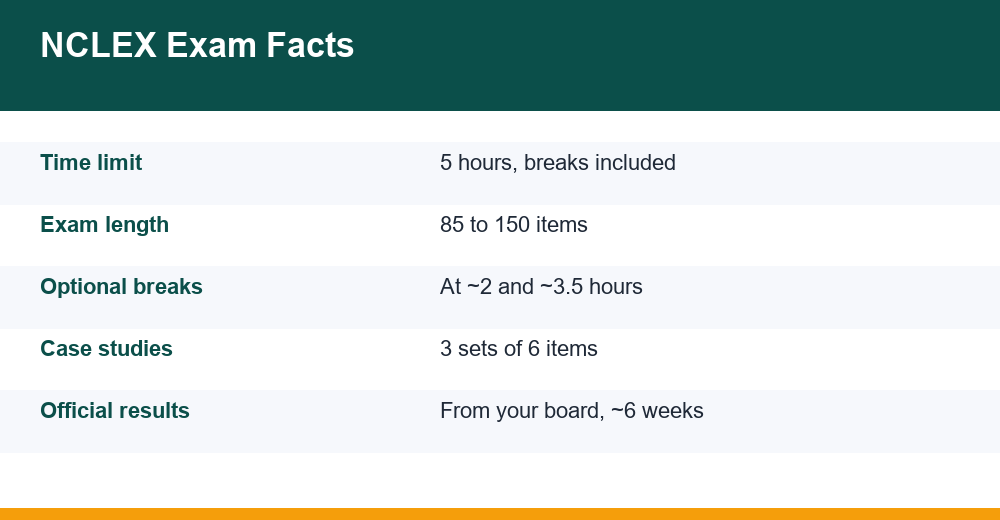
- Variable length. Both the NCLEX-RN and NCLEX-PN can end anywhere from 85 to 150 items, and you will not know in advance when yours will stop.
- A hard time cap. The total limit is five hours, and that includes the introductory screens and every break you take.
- No going back. Because the test adapts, you answer each item and move on; you cannot return to change earlier responses.
- Unscored items you cannot spot. Every exam carries 15 pretest items that do not count, and they look exactly like scored ones.
- Unfolding case studies. Three clinical case studies of six items each walk you through one patient’s situation, which can feel long and heavy.
Knowing these facts ahead of time removes a big chunk of the uncertainty that drives worry. When a run of brutal questions appears, you can recognize it as the algorithm doing its job rather than as proof that you are failing.
It also helps to name what you are dealing with. For most candidates, NCLEX test anxiety is ordinary performance stress: a racing heart, a tight chest, blanking on a familiar drug, catastrophic thoughts about the future. Those reactions respond well to preparation and simple physical resets, which is what the rest of this guide covers.
Weeks Before: Build Calm Into Your Prep
The calmest test-takers rarely got there with last-minute tricks. They removed surprises weeks in advance. Here are the first four of the nine tactics.
1. Rehearse under real conditions
Take at least two or three full-length practice sessions in one sitting, timed, with your phone in another room. Build in breaks at roughly the two-hour and three-and-a-half-hour marks so your body learns the rhythm of the real day. Endurance is a skill, and fatigue amplifies anxiety.
2. Study from the official test plan
NCSBN publishes separate NCLEX-RN and NCLEX-PN test plans that list every content area the exam can cover, and the current editions took effect in April 2026. Mapping your weak areas against the plan turns a vague feeling of “I don’t know enough” into a concrete list you can shrink each week.
3. Practice every item type
Next Generation item formats such as matrix grids, drag-and-drop, highlighting and bow-tie questions should feel routine before test day. Meeting a new layout for the first time under pressure is a classic trigger for freezing.
4. Use evidence, not feelings, to judge readiness
Anxious candidates often postpone indefinitely or rush in too early. Instead, check objective markers such as consistent practice scores and stable performance on case studies. Our guide to signs you are ready for the NCLEX lays out what to look for.
A simple countdown keeps the final stretch structured without overloading you:
| Timeframe | Focus | Anxiety payoff |
|---|---|---|
| 4-6 weeks out | Content gaps from the test plan | Shrinks the “unknown” list |
| 3-4 weeks out | All NGN item types and case studies | No surprise formats |
| 2-3 weeks out | Full timed sessions with breaks | Builds stamina and pacing |
| Final week | Light review, sleep, logistics | Protects energy and focus |
| Night before | Rest, ID ready, route checked | Removes morning panic |
If you notice that your NCLEX test anxiety spikes mostly during timed practice, treat that as useful data. Lengthen your timed sets gradually rather than avoiding them; avoidance tends to make the fear grow.
How to Calm Your Nerves Before the NCLEX
In the last few days, the goal shifts from learning new material to settling your nervous system. Two more tactics belong here.
5. Learn one breathing reset and practice it daily
Pick a single, simple pattern and use it every day so it becomes automatic. A common option is slow-exhale breathing: breathe in through the nose for about four counts, then out through the mouth for about six. Longer exhales tend to steady a racing heart.
Practice it before each study block and before every practice test. On exam day you will not have to think about the technique, because your body will already know it.
6. Script your self-talk
Write down two or three short, believable statements and read them each morning, for example: “Hard questions are normal on an adaptive test,” or “I only need to answer the item in front of me.” Skip empty hype; your brain rejects claims it does not believe.
Other habits that help in the final days:
- Keep caffeine at your usual level rather than adding extra.
- Move your body daily, even if it is just a 20-minute walk.
- Limit time in group chats where classmates swap horror stories.
- Plan a small reward for after the exam, however you feel walking out.
If you have been sleeping poorly for weeks or feel unable to function, talk with a counselor, your school’s student support services or a health professional. Those are signs that self-help tactics alone may not be enough.
Should You Study the Day Before the NCLEX?
For most people, the answer is: very little. Heavy cramming the day before tends to raise stress and cut into sleep, and it rarely adds meaningful knowledge. A short, light review of a few familiar topics is fine if it calms you; a marathon session usually does the opposite.
7. Run a night-before checklist
- Confirm your appointment time and test center address in your Pearson VUE account.
- Set out the acceptable ID you used at registration, and make sure the name matches exactly.
- Check your route and plan to arrive at least 30 minutes early; arriving more than 30 minutes late can mean forfeiting your appointment.
- Lay out comfortable layered clothing, since room temperatures vary.
- Pack a simple snack and water to keep in your locker for breaks.
- Go to bed at your usual time, not unusually early.
The morning deserves a plan too. Eat a familiar breakfast, avoid opening flashcards in the parking lot, and do one round of your breathing reset before you walk in. For a full walkthrough of check-in, security and what to bring, see our NCLEX test day guide.
In-Exam Tactics: Resets Between Case Studies
Once the exam starts, your job is narrow: one item at a time. Tactic eight is about catching stress early instead of letting it snowball.
8. Use micro-resets at natural transition points
The three unfolding case studies make natural checkpoints. When you finish one, take 10 to 20 seconds: sit back, drop your shoulders, unclench your jaw and do two or three of your practiced breaths before starting the next item. That tiny pause costs almost nothing against a five-hour limit.
Use the same reset whenever you notice warning signs, such as rereading a stem three times without absorbing it, or feeling your pulse in your ears.
What to do when you blank on a question
- Reread the last sentence of the stem to pin down what is actually being asked.
- Ask which answer keeps the patient safest right now.
- Eliminate options you know are wrong, choose the best remaining one and move on.
- Let it go. One item does not decide your result, and it may even be an unscored pretest item.
Avoid counting items or trying to guess whether the test is about to shut off. That mental math pulls attention away from the question on screen, which is the only one you can influence.
Pacing matters as well. With up to 150 items in five hours, you have room to think, but not to agonize. If you catch yourself spending several minutes on a single standalone item, make your best clinical choice and continue.
Can You Take a Break During the NCLEX?
Yes. According to official exam-day guidance, the NCLEX offers two optional scheduled breaks, and you can also take unscheduled breaks. The catch: the exam clock keeps running during every break, and all break time counts against your five hours.
| Break type | When it is offered | Clock running? |
|---|---|---|
| First optional break | After about 2 hours of testing | Yes |
| Second optional break | After about 3.5 hours of testing | Yes |
| Unscheduled break | When you request one | Yes |
9. Decide your break plan in advance
Choosing ahead of time removes one more decision from exam day. Many candidates find a short break helpful even when they feel fine: stand up, stretch, drink water, eat a few bites and do one round of breathing. A few minutes of reset can restore focus for the next stretch.
Keep breaks brief, and expect to go through check-in steps again when you return to your seat. Because procedures can be updated, confirm the current break rules and the latest Candidate Bulletin through NCSBN, the organization that develops the NCLEX.
Is It Normal to Feel Like You Failed?
Very normal. Post-exam doubt is one of the most common forms of NCLEX test anxiety. Because the exam adapts to keep pushing you toward the edge of your ability, many candidates walk out convinced they failed, including plenty who passed. Feeling uncertain afterward is not a reliable predictor of your result.
NCSBN states that the number of items alone does not reveal pass or fail. Some candidates finish at 85 items, others go much longer, and both groups include passes and fails.
How to handle the waiting period
- Official results come only from your nursing regulatory body and are sent within about six weeks of the exam.
- Unofficial Quick Results are available for a fee in participating US jurisdictions, generally about two business days after testing.
- Do not call NCSBN, Pearson VUE or the test center asking for results; they cannot release them.
- Ignore online tricks that claim to predict outcomes. They add stress and are not official.
Use the wait to recover. Replaying every question will not change the outcome, so lean on friends, catch up on sleep and do something unrelated to nursing for a few days.
When NCLEX Test Anxiety Needs Accommodations
For most candidates, the tactics above are enough. But if NCLEX test anxiety is part of a documented condition, such as a diagnosed anxiety disorder, you may be able to request formal testing accommodations.
The process runs through your nursing regulatory body (NRB), not the test center. Accommodations can only be provided with NRB authorization, and the general sequence looks like this:
- Check your board of nursing’s specific rules and documentation requirements.
- Submit your request to the board as early as possible, ideally before registering with Pearson VUE.
- Wait for the review; NCSBN also reviews requests to protect fairness and exam security.
- Schedule your exam only after you receive written confirmation of approved accommodations.
What gets approved depends on your documentation and your board’s decision, so do not assume a particular outcome. Reviews take time, which is why starting early matters. Our detailed guide to NCLEX testing accommodations explains the steps and common pitfalls.
Whichever path applies to you, the core message is the same: the exam is predictable in its structure, your reactions can be trained, and the license is earned only by passing the real test. Prepare steadily, practice your resets, and walk in knowing that difficult questions are part of the design.
Frequently Asked Questions
How do I calm my nerves before the NCLEX?
Practice one breathing pattern daily, such as inhaling for four counts and exhaling for six, so it becomes automatic. Take full timed practice tests with breaks, prepare your ID and route the night before, and arrive at least 30 minutes early. Avoid cramming and group chats full of horror stories in the final days.
Should I study the day before the NCLEX?
Keep it light. A short review of familiar topics is fine if it calms you, but heavy cramming usually raises stress and cuts into sleep without adding much knowledge. Spend the day confirming logistics, laying out your ID and clothing, eating normally and going to bed at your usual time.
Can I take a break during the NCLEX?
Yes. Two optional scheduled breaks are offered, after about two hours and about three and a half hours of testing, and you may take unscheduled breaks too. The exam clock keeps running during all breaks, and break time counts toward the five-hour limit, so keep breaks short and purposeful.
Can I get accommodations for test anxiety on the NCLEX?
Possibly, if your anxiety is a documented condition. Requests go through your nursing regulatory body, which must authorize any accommodation, and NCSBN reviews them as well. Submit early, ideally before registering with Pearson VUE, follow your board’s documentation rules, and schedule only after written approval arrives.