NCLEX SATA questions make more test-takers nervous than any other format, partly because prep guides still contradict each other on how they are scored. This guide settles the partial-credit question using NCSBN’s published scoring rules, then walks through seven strategies and three worked examples you can practice with today.
Table of Contents
What NCLEX SATA Questions Look Like Today
NCSBN officially calls this format the multiple response item. You recognize it by the instruction “Select all that apply” in the question. According to NCSBN, that instruction means one or more of the listed options is a correct answer, or “key”.
Classic stand-alone items give you a short clinical stem and a list of options, often five or six. Next Generation NCLEX (NGN) items, introduced in April 2023, can wrap the same select-all task inside a case study, sometimes with exhibits such as vital signs, lab values or nurses’ notes that you must read first.
SATA sits alongside matrix, drag-and-drop, cloze (drop-down) and highlight formats. If you want a tour of every format before going deeper here, see our overview of all NCLEX question types.
How many SATA items will you get?
Nobody can tell you an exact number. The exam uses computerized adaptive testing (CAT), which selects items based on your estimated ability and the content areas of the test plan, not on a quota of item formats. Some candidates see many select-all items; others see relatively few.
For context, the NCLEX-RN runs between 85 and 150 items within a five-hour limit that includes breaks. The minimum-length exam contains three case studies of six items each, and every exam includes 15 unscored pretest items that look exactly like scored ones.
Do You Get Partial Credit on SATA Items?
Yes. This is where older blogs and newer ones clash, so here is the official position. Since the NGN launch, NCSBN applies partial credit scoring to items with more than one key, using three methods: plus/minus, zero/one and rationale scoring.
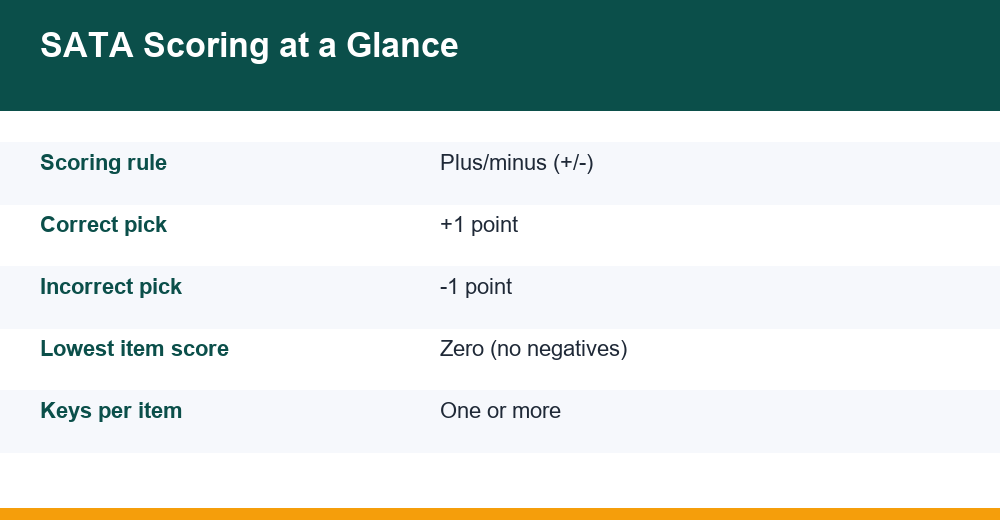
Select-all items fall under the plus/minus (+/-) rule, which NCSBN uses when candidates may select an unspecified number of options. You earn a point for each correct option you select and lose a point for each incorrect option you select. The maximum equals the number of keys, and the item score cannot drop below zero.
The “all or nothing” claim you still see online comes from the pre-2023 exam, when SATA items were scored dichotomously: every key and no distractors, or zero. That rule no longer describes the current NCLEX.
Plus/minus scoring in practice
Imagine an item with six options, three of which are keys. Here is how different response patterns score under the rule:
| Your selections | Correct picks | Wrong picks | Item score |
|---|---|---|---|
| All 3 keys only | 3 | 0 | 3 of 3 |
| All 3 keys plus 1 distractor | 3 | 1 | 2 of 3 |
| 2 keys, no distractors | 2 | 0 | 2 of 3 |
| 2 keys plus 1 distractor | 2 | 1 | 1 of 3 |
| 2 keys plus 2 distractors | 2 | 2 | 0 of 3 |
| 1 key plus 2 distractors | 1 | 2 | 0 (floor, not -1) |
| Every option selected | 3 | 3 | 0 of 3 |
Two lessons jump out. First, selecting everything “just to be safe” earns nothing when the distractors cancel out the keys. Second, leaving off a key you are unsure about costs the same single point as adding a distractor, so every option deserves a real decision.
Other scoring rules you may meet
- Zero/one: used when the item tells you to choose a specific number of responses (for example, “Select 3”). Correct picks earn points; wrong picks simply earn nothing.
- Rationale: used for paired information, where both linked parts must be correct to earn the point.
- Item scores feed a statistical model that places them on the NCLEX ability scale. For how that ability estimate becomes a pass or fail, read how NCLEX scoring works.
Scoring details, test plans and the candidate tutorial are all published by the exam’s owner, the National Council of State Boards of Nursing (NCSBN). When a prep blog disagrees with NCSBN, trust NCSBN.
How Many Answers Are Correct, and Can All Be Right?
There is no official “usual” number. NCSBN’s wording only promises that one or more options will be correct. Rumors such as “there are always at least two” or “never all five” are not based on any published NCSBN rule.
Practice banks and NCSBN’s own sample items show a wide spread, from a single key to most of the list. No pattern is reliable enough to bet points on, and under plus/minus scoring a wrong bet now costs you.
Can every option be correct?
Nothing in NCSBN’s description rules it out. The instruction means one or more options are correct, and “more” can include all of them. It is uncommon in practice tests, but if each option survives honest true/false scrutiny, select them all.
Can only one option be correct?
Yes. A select-all item with a single key is fully consistent with the official definition. You also have to answer each item before moving on, so a blank response is not an option.
The practical takeaway: never let the count drive your choices. Decide each option on its merits, then accept whatever total you end up with, whether that is one, four or all of them.
7 Proven Strategies for NCLEX SATA Questions
These strategies line up with the plus/minus rule. Each one aims to catch more keys while keeping distractors out, which is exactly what earns points on NCLEX SATA questions.
- Answer the stem before you read the options. Restate the question in your own words: who is the client, what is the problem, and what is being asked (findings, interventions, teaching, priorities)? Form a rough list of expected answers first so the options do not lead you.
- Turn every option into a true/false statement. Read the stem, then one option, and ask “Is this true for this client in this situation?” Cover the other options mentally. This removes the comparison habit that works on single-answer items but fails here.
- Anchor on the client in front of you. An option can be true in general and still be wrong for this stem. Check age, diagnosis, timing (pre-op versus post-op, day 1 versus discharge) and any lab values given.
- Watch qualifiers in the stem. Words like “early,” “priority,” “further teaching needed” or “expected finding” change which options count. A “further teaching needed” stem flips the logic: you are looking for incorrect client statements.
- Filter through safety frameworks. Airway, breathing and circulation; Maslow’s hierarchy; and infection-control principles help you judge whether an intervention belongs, especially in “which actions should the nurse take” items.
- Be cautious with absolutes, not blind. Words such as “always” or “never” are often wrong in clinical care, but some absolutes are correct (for example, never recapping a used needle). Treat them as a prompt to think, not an automatic elimination.
- Commit and move on. You cannot return to earlier items on the NCLEX, and there is no per-item time limit within the five-hour exam. Make your true/false call on each option, confirm you have not misread the stem, submit and reset for the next item.
Under plus/minus scoring, guessing is no longer free. A random extra pick costs a point if it is wrong, so add an uncertain option only when your clinical reasoning gives it better than even odds.
Worked Examples: The Option-by-Option Method
These practice items were written for this guide. They are not real exam items, but they model the reasoning the format rewards.
Example 1: Expected findings
A client has a serum potassium of 2.9 mEq/L. Which findings would the nurse expect? Select all that apply. Options: (A) muscle weakness, (B) flattened T waves, (C) peaked T waves, (D) presence of U waves, (E) hyperactive deep tendon reflexes.
| Option | True or false for this client? | Reasoning |
|---|---|---|
| A. Muscle weakness | True | Low potassium impairs muscle contraction |
| B. Flattened T waves | True | Classic ECG change in hypokalemia |
| C. Peaked T waves | False | Associated with hyperkalemia |
| D. U waves | True | Commonly seen with low potassium |
| E. Hyperactive reflexes | False | Hypokalemia tends to diminish reflexes |
Keys: A, B and D. A candidate who picked A, B, C and D would score 3 minus 1, or 2 of 3. Mixing up hypo- and hyper- states is a frequent source of lost points on electrolyte items, which is where memory aids help; our collection of NCLEX mnemonics covers electrolytes and more.
Example 2: Nursing actions
A client receiving chemotherapy has severe neutropenia. Which actions should the nurse include in the plan of care? Select all that apply. Options: (A) perform hand hygiene before entering the room, (B) place a bouquet of fresh flowers at the bedside, (C) avoid taking rectal temperatures, (D) restrict visitors who have respiratory symptoms, (E) monitor temperature for early signs of infection.
- A: True. Hand hygiene is the core infection-prevention measure.
- B: False. Fresh flowers and standing water are typically restricted for neutropenic clients.
- C: True. Rectal procedures risk mucosal injury and infection.
- D: True. Limiting exposure to ill visitors protects the client.
- E: True. Fever may be the first sign of infection when white cells are low.
Keys: A, C, D and E, four out of five. A test-taker who believes “it is never four” would lose a point here, which is why counting rules are unreliable.
Example 3: A negatively worded stem
The nurse teaches a client about a new prescription for warfarin. Which statements indicate a need for further teaching? Select all that apply. Options: (A) “I will use a soft toothbrush,” (B) “I can take aspirin for headaches,” (C) “I will keep my blood test appointments,” (D) “I will double my dose if I miss one.”
Because the stem asks for statements needing more teaching, you are hunting for incorrect client statements. A and C are correct behaviors, so they are not selected. B (aspirin adds bleeding risk) and D (doubling doses is unsafe) are the keys. Rewording the stem as “Which statements are wrong?” before evaluating options prevents a reversal error.
Are SATA Items Harder on the Next Generation NCLEX?
In some ways they feel harder, and in one important way they are fairer. NGN case studies are built around the six steps of the NCSBN Clinical Judgment Measurement Model: recognize cues, analyze cues, prioritize hypotheses, generate solutions, take action and evaluate outcomes.
That means you may need to pull cues from a chart before you can judge options, and option lists can be longer than the classic five. Reading load goes up, and so does the temptation to overthink.
The fairer part is partial credit. Under the old dichotomous rule, one slip zeroed out the whole item. Under plus/minus scoring, partial knowledge is rewarded, while random guessing is discouraged by the deductions.
| Feature | Pre-2023 NCLEX | Current NCLEX (NGN) |
|---|---|---|
| Scoring of select-all items | All or nothing | Plus/minus partial credit |
| Context | Mostly short stand-alone stems | Stand-alone items and case studies |
| Exhibits | Occasional | Common in case studies |
| Effect of one wrong pick | Whole item lost | One point deducted |
Also remember that difficulty is personal under CAT. The exam keeps choosing items you are expected to find challenging, so feeling stretched by NCLEX SATA questions is normal and does not by itself signal failure.
How to Study for Select-All-That-Apply Questions
Strategy only works on top of content knowledge. Most missed SATA options trace back to a fuzzy fact, not a test-taking trick. Build your preparation in layers.
A four-week SATA routine
| Week | Focus | Daily task |
|---|---|---|
| 1 | Content gaps | Review one body system, then 15 select-all items on it |
| 2 | True/false habit | Write T or F beside every option before checking answers |
| 3 | Case-study practice | Work one unfolding case study and its select-all items |
| 4 | Timed mixed sets | Mixed formats under realistic timing, then full review |
Review smarter, not just more
- Score practice items the plus/minus way, not just right or wrong. Tracking partial scores shows whether you tend to over-select or under-select.
- For every option you missed, write one line explaining why it was true or false. This converts mistakes into facts you keep.
- Group errors by cause: knowledge gap, misread stem, ignored client detail or overthinking.
- Work through the free official candidate tutorial on NCLEX.com to get used to the real item layout and controls.
- Rest before test day. Fatigue increases misreads on long, multi-option items.
If your practice data shows you over-select, tighten your threshold for adding an uncertain option. If you under-select, revisit content in the weak area, because missing keys usually signals a gap rather than caution.
This site sells nothing and is not affiliated with NCSBN. The only way to earn a license is by passing the real exam through your board of nursing, so focus on understanding over memorizing answer patterns for NCLEX SATA questions.
Common SATA Mistakes to Stop Making
Most lost points on NCLEX SATA questions come from a handful of repeat habits. Catching them in practice is the fastest way to raise your score.
- Counting answers. Deciding in advance that there “must be” two or three keys leads to dropping true options or adding false ones.
- Comparing options to each other. SATA options are judged against the stem, not ranked against one another.
- Selecting everything that sounds nice. Generically good nursing actions can still be wrong for this specific client.
- Missing negative stems. “Needs further teaching” and “contraindicated” stems reverse what you select.
- Assuming all-or-nothing scoring. Believing one slip ruins the item can lead to panic; partial credit means every correct decision counts.
- Changing answers on vague doubt. Switch only when you spot a specific reason, such as a misread lab value or overlooked qualifier.
Build the option-by-option habit until it is automatic, and select-all items stop being a guessing game and become a straightforward check of what you know.
Frequently Asked Questions
Do you get partial credit on NCLEX SATA questions?
Yes. NCSBN scores select-all items with the plus/minus rule. You earn one point for each correct option you choose and lose one point for each incorrect option, with the item score never dropping below zero. The maximum score equals the number of correct options, so partial knowledge counts, but random guessing is penalized.
How many answers are usually correct on SATA questions?
There is no official typical number. NCSBN only states that one or more options will be correct. Practice and sample items range from a single key to most of the list, so no count is reliable. Judge each option independently as true or false for the client in the stem rather than aiming for a target number.
Can all options be correct on a SATA question?
Yes, it is possible. The official definition says one or more of the provided options will be correct, which does not exclude every option being a key. It is uncommon, but if each option holds up as true for that specific client and stem, selecting all of them is the right response.
How do you study for select all that apply questions?
Start by strengthening content knowledge, since most misses come from fuzzy facts. Practice writing true or false beside every option, review rationales for each one, and track whether you over- or under-select. Add case-study practice and timed mixed sets, and use the free candidate tutorial on NCLEX.com to learn the real layout.