
The most reliable NCLEX readiness signs come from patterns in your own practice work, not from a gut feeling or a single high score. This guide walks through eight objective checks you can run on yourself, built around the current test plan, so you can decide whether to book your exam date or give yourself a few more weeks. Nothing here requires buying a predictor test.
Table of Contents
What NCLEX Readiness Signs Actually Measure
The NCLEX does not reward you for knowing a lot of facts. It asks one question over and over: is this candidate’s ability clearly above the passing standard? Everything you use to judge your own readiness should point at that same question.
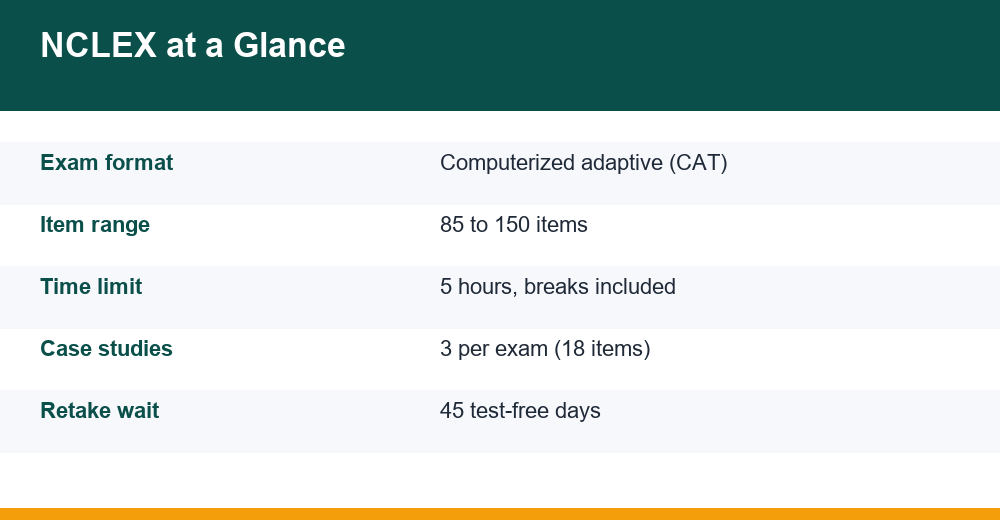
Both the NCLEX-RN and NCLEX-PN are computerized adaptive tests. Every candidate answers at least 85 items and no more than 150, within a five-hour window that includes all breaks. Of the 85-item minimum, 52 scored items come from the content areas, 18 items make up three clinical judgment case studies, and 15 are unscored pretest items.
The official exam details and current test plans are published on the NCLEX website run by NCSBN. Read the plan for your exam before you start judging yourself against it.
The exam stops when the computer is 95% confident your ability sits clearly above or clearly below the standard. That is why the number of items you receive tells you nothing on its own, and why your preparation should aim for steady performance across many question types, not lucky streaks.
So when we talk about readiness, we mean three things you can observe:
- Consistency: your practice results hold steady across weeks and topics, not just on good days.
- Reasoning: you can explain why the right answer is right and why each distractor is wrong.
- Coverage: no single content area is dragging you down far enough to sink an adaptive exam.
Notice what is missing from that list: how confident you feel, how many hours you have logged, and what a friend scored. Those things are easy to measure but say little about how the adaptive algorithm will see you.
8 NCLEX Readiness Signs You Can Check Objectively
Run through these eight checks honestly. Write down a yes or no for each, with a note on the evidence. If you only answer yes based on how you feel, mark it as a no until you can point to data. Taken together, these NCLEX readiness signs give you a far clearer picture than any one percentage.
1. Your scores trend flat or upward over several weeks
Look at your last 10 to 15 practice sessions, not your best one. A stable trend line matters more than a peak. If your results swing wildly between sessions, your knowledge is still patchy.
2. You can explain every rationale before reading it
Pick ten questions you got right. Cover the rationale and say aloud why your answer was correct and why the others were wrong. If you guessed correctly on more than two, those were not really correct answers.
3. Your wrong answers follow a pattern you can name
Ready candidates know exactly why they miss questions: misreading the stem, choosing an assessment when the client needs an intervention, or forgetting a lab range. Random, unexplained misses suggest gaps you have not found yet.
4. No content area is far below the rest
Adaptive testing pulls items from every client needs category. One badly weak area, such as pharmacology, can keep the exam from ever reaching a confident pass decision.
5. NGN case studies no longer feel foreign
You can work through a six-item case study, track how the client changes, and handle bowtie, matrix and highlight formats without losing time to the format itself.
6. You finish timed sets with time to spare
Five hours for up to 150 items is generous, but slow readers who agonize over each item can run short. If you consistently finish timed blocks early without rushing, pacing is not your risk.
7. Prioritization questions feel routine
Questions about who to see first, what to delegate, and what to do next form the backbone of Management of Care. If you reach for frameworks like ABCs, Maslow and acute-versus-chronic automatically, that is a strong sign.
8. You can stay calm after a hard question
Difficult items on an adaptive test often mean you are doing well. If one tough question still derails the next five, practice recovery techniques from our guide on managing NCLEX test anxiety before you sit.
Use this summary to record your answers in one place:
| Sign | Evidence to look for | Red flag |
|---|---|---|
| Score trend | Last 10-15 sessions flat or rising | Big swings between sessions |
| Rationales | Can explain answers unaided | Correct answers were guesses |
| Error patterns | Misses fit a few named types | Misses look random |
| Content balance | No area far below average | One high-weight area lagging |
| NGN comfort | Case studies done calmly | Format still slows you down |
| Pacing | Timed blocks finished early | Rushing the last items |
| Prioritization | Frameworks used automatically | Guessing who to see first |
| Recovery | Hard item does not derail you | Panic spreads to next items |
What Practice Score Means You Are Ready?
There is no official practice score that predicts a pass. NCSBN publishes no conversion between any question bank’s percentages and the NCLEX passing standard, and each commercial bank calibrates its difficulty differently. A 60% on a hard bank may represent stronger ability than an 80% on an easy one.
What you can do is read your scores in context. Many question banks show how your score compares with other users on the same items. Being consistently above the average of other users on a reputable bank, across all content areas, is more meaningful than any raw number.
Use these practical rules of thumb, and treat them as approximate:
- Judge the average of your last several full-length or mixed sets, never a single session.
- Ignore scores on questions you have seen before; repeats inflate results.
- Weight mixed, timed sets more heavily than untimed, single-topic quizzes.
- If your bank offers a percentile or peer comparison, track that rather than the percentage.
- Watch for a steady slope: a rise from the low 50s to the mid 60s over a month, for example, says more than one high result.
School-administered exit or standardized exams can also give you a benchmark, because your program has seen how its own graduates perform afterward. If your school set a target, ask your faculty how closely it has tracked with recent pass outcomes.
How Many Practice Questions Should You Do?
You will see big numbers quoted online, from 1,500 to more than 3,000 questions. No official source sets a required count, and volume alone does not build readiness. A candidate who completes 1,500 questions and studies every rationale often learns more than one who rushes through 4,000.
A workable target for many graduates is somewhere around 75 to 150 questions a day during focused study, with roughly as much time spent on rationales as on answering. Over six to eight weeks, that lands most people in the low thousands, which is plenty if the review is thorough. These figures are common guidance, not an official requirement.
Quality checks matter more than the total:
- Answer in timed, mixed blocks to mimic the real exam’s unpredictability.
- Read every rationale, including those for questions you got right.
- Log each miss by content area and error type in a simple spreadsheet.
- Revisit your log weekly and build mini-reviews around the top two error types.
- Include NGN case studies every week, not just in the final stretch.
If you need a structure for spreading that volume across the weeks, our NCLEX study plan lays out a day-by-day schedule you can adapt to your graduation date and work hours.
Mapping Weak Spots Against the Test Plan
The test plan tells you how much of the exam each area represents. Comparing your practice results to these weights shows where a weakness will cost you most.
The ranges below are the NCLEX-RN client needs weights as published in recent test plans. NCSBN reviews its plans every three years, so confirm the figures against the plan in force on your test date.
| Client needs area (RN) | Share of scored items | What weakness looks like |
|---|---|---|
| Management of Care | 15-21% | Missing delegation, priority and legal or ethical questions |
| Safety and Infection Control | 10-16% | Confusing isolation types, fall and restraint rules |
| Health Promotion and Maintenance | 6-12% | Gaps in growth milestones, prenatal and screening care |
| Psychosocial Integrity | 6-12% | Weak therapeutic communication and crisis responses |
| Basic Care and Comfort | 6-12% | Errors on nutrition, mobility, elimination and rest |
| Pharmacological and Parenteral Therapies | 13-19% | Mixing up drug classes, adverse effects, dosage math |
| Reduction of Risk Potential | 9-15% | Missing abnormal labs and procedure complications |
| Physiological Adaptation | 11-17% | Struggling with acute changes, fluid and electrolyte shifts |
PN candidates should use the NCLEX-PN plan, which has different category names and weights, such as Coordinated Care in place of Management of Care.
A practical rule: if any high-weight area such as Management of Care or Pharmacology sits well below your overall average, treat it as a red flag even if your total looks fine. Spend a focused week there, then retest with fresh questions before booking.
Checking Your Comfort With NGN Case Studies
Since April 2023, the exam has measured clinical judgment directly through Next Generation NCLEX items. Each of the three case studies contains six items that follow one client, built around the steps of NCSBN’s Clinical Judgment Measurement Model: recognize cues, analyze cues, prioritize hypotheses, generate solutions, take action and evaluate outcomes.
Standalone NGN items, such as bowtie and trend questions, also appear outside the case studies. Many of these use partial-credit scoring, so careful reasoning earns points even when you do not get every option right.
Ask yourself these questions after a few case studies:
- Can I pick out the abnormal cues in a long chart without rereading it three times?
- Do I connect cues to the most likely problem before looking at the options?
- When the scenario updates, do I notice what got better and what got worse?
- Can I complete a bowtie item by reasoning from the condition outward, not guessing each column?
- Am I avoiding the trap of selecting every option in select-all-that-apply items?
If most answers are yes, case studies are an asset rather than a threat. If they still feel slow or confusing, add a daily case study and talk through each step aloud, as if precepting a student.
Should You Postpone the NCLEX If You Feel Unprepared?
Feeling unprepared and being unprepared are different. Almost nobody walks into the NCLEX feeling fully ready. Base the decision on the evidence you gathered above, not on nerves. If most NCLEX readiness signs check out and only your confidence lags, rescheduling usually just extends the anxiety.
A delay makes sense when the data is clearly against you: scores trending down, a high-weight content area well below the rest, or case studies you still cannot finish. In that case, a short, targeted postponement of a few weeks with a specific plan is reasonable. Check Pearson VUE’s rescheduling rules and your Authorization to Test validity window first so you do not lose your registration.
How long should you study after graduation?
Many new graduates study for roughly four to eight weeks, though the right length depends on your school performance, work schedule and practice trends. There is no official minimum or maximum.
What matters is not drifting. NCSBN research has linked longer gaps between graduation and testing with lower first-time pass rates. That is an association rather than proof of cause, since candidates who wait may differ in other ways, but it is a good reason not to postpone indefinitely while waiting to feel perfect.
If you do test and do not pass, the standard NCSBN policy requires 45 test-free days between attempts, and some boards of nursing set stricter limits. Understanding the common reasons in why candidates fail the NCLEX can help you avoid the same traps the first time.
A Ready-or-Not Checklist for Your Final Week
Use this final check about seven days before your appointment. If you can tick most items honestly, keep your date. If several are unchecked, consider a brief, focused delay with a written plan.
- My average on mixed, timed practice has held steady or risen for at least two to three weeks.
- I have reviewed the rationale for every question in my last several sets.
- My error log shows misses shrinking in my previously weakest content area.
- No high-weight client needs area is far below my overall average.
- I can complete NGN case studies within a comfortable time and explain each answer.
- I finish timed blocks without rushing the final questions.
- I have confirmed my ID, appointment time and test center route.
- I have a plan for sleep, meals and breaks on exam day.
In the final days, avoid cramming new content. Do light mixed review, revisit your error log, and rest. These NCLEX readiness signs are about patterns built over weeks; a last-minute marathon will not change them, but exhaustion can undo them.
Remember that the license is earned only by passing the real exam administered through Pearson VUE. Free practice and honest self-assessment are enough to make a sound decision about when to sit.
Frequently Asked Questions
How do I know if I am ready for the NCLEX?
Look for evidence, not feelings. Ready candidates show a stable or rising trend on mixed, timed practice, can explain rationales before reading them, have no content area far below the rest, and handle NGN case studies comfortably. If most of these checks hold for two to three weeks, you are likely ready to book your exam.
What practice score means I am ready for the NCLEX?
No official practice score predicts a pass, because each question bank sets its own difficulty and NCSBN publishes no conversion. Instead, track your average across several mixed sets and compare yourself with other users on the same bank. Being consistently above average in every content area is more meaningful than any single percentage.
How many practice questions should I do before the NCLEX?
There is no required number. Many graduates complete somewhere in the low thousands over six to eight weeks, often 75 to 150 a day. The total matters less than review quality: read every rationale, log your errors by content area, and include NGN case studies each week so the format feels familiar.
Should I postpone my NCLEX if I feel unprepared?
Only if your data supports it. Nervousness alone is not a reason to delay. Postpone briefly if scores are falling, a heavily weighted area is clearly weak, or case studies still confuse you. NCSBN research links longer gaps after graduation with lower pass rates, so keep any delay short and targeted.