This NCLEX PN study guide is built directly on the official 2026 NCLEX-PN test plan, which took effect on April 1, 2026, and runs through March 31, 2029. Instead of recycling RN material or outdated summaries, it maps every Client Needs category to what practical nurse candidates should actually study, in what order and for how long. Nothing here is for sale, and the only way to earn a license is to pass the real exam.
Table of Contents
How the NCLEX-PN Works in 2026
The NCLEX-PN is a computerized adaptive test (CAT). After each answer, the computer estimates your ability and picks the next item so that it is neither too easy nor too hard for you. That is why two candidates sitting the exam on the same day can finish with very different numbers of questions.
How many questions are on the NCLEX-PN in 2026?
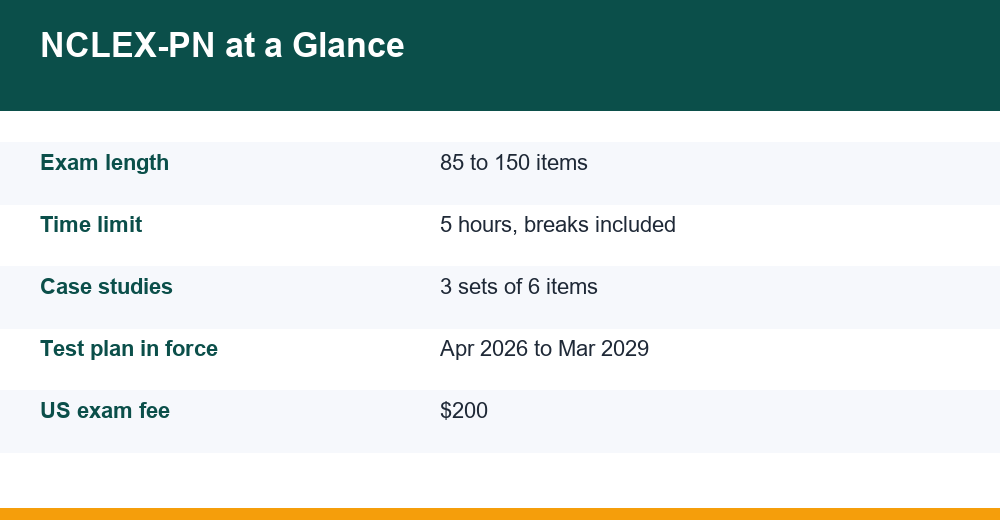
Every candidate answers at least 85 items and no more than 150, within a five-hour limit that includes all breaks. At the minimum length, the exam contains 52 items drawn from the eight content areas, 18 items in three clinical judgment case studies and 15 unscored pretest items. You cannot tell which items are pretest, so treat every question as if it counts.
| Exam component | Items at minimum length | Scored? |
|---|---|---|
| Content-area items | 52 | Yes |
| Case studies (3 sets of 6) | 18 | Yes |
| Pretest items | 15 | No |
| Total minimum | 85 | 70 scored |
| Maximum length | 150 | Pretest still 15 |
When does the exam stop?
The official test plan describes three stopping rules:
- 95% confidence rule: the most common outcome. The exam ends once the computer is 95% certain your ability is clearly above or below the passing standard, as long as you have answered the minimum number of items.
- Maximum-length exam: if your ability stays close to the standard, you keep answering until item 150, and the decision rests on your final ability estimate.
- Run-out-of-time rule: if time expires before you reach 85 items, the result is a fail. If you reached the minimum, the exam is scored on your final ability estimate.
In practice, many candidates finish at or near the minimum length, while a smaller group goes all the way to 150. Neither outcome tells you anything certain about your result, so do not read meaning into the number of items you see.
A good NCLEX PN study guide should therefore train stamina as well as knowledge. You need to stay focused for up to five hours, even though most people finish far sooner. Build at least two long, timed practice sessions into your plan so the real clock feels familiar.
What Changed in the 2026 NCLEX-PN Test Plan
NCSBN reviews its test plans on a three-year cycle. The 2026 edition is in force from April 1, 2026, through March 31, 2029. The headline is reassuring: the content weighting did not change. The Client Needs percentage ranges match those in the 2023 plan, and the exam length, time limit and item mix stay the same.
The changes that do matter for your preparation are these:
- Renamed category: “Safety and Infection Control” is now “Safety and Infection Prevention and Control,” signaling a stronger focus on preventing infections, not only containing them.
- Updated practice analysis: activity statements are drawn from a newer survey of newly licensed LPN/VNs, who reported how often they perform nursing tasks and how important those tasks are to safe care.
- Expanded overview: the introduction adds more detail on how the exam is administered and how clinical judgment is measured.
- Unchanged passing logic: the exam still compares your ability estimate with a fixed passing standard, currently -0.18 logits for the PN exam.
If you own a review book printed for the 2023 plan, its core content is still largely valid. What you should double-check are the category names and any claims that the exam format changed, because it did not. For a side-by-side look at both licensure exams under the new edition, see our breakdown of the 2026 NCLEX test plan.
One practical tip: when a question bank labels items by category, map the old safety label to the new one in your error log so your statistics stay consistent across resources.
NCLEX PN Study Guide: Client Needs Priorities
The test plan groups content into four major Client Needs categories, two of which are split into subcategories, for eight content areas in total. Each area has an official percentage range, and the midpoint is a reasonable estimate of the typical share of items. Your own exam can vary within each range because the test is adaptive.
| Content area | Official range | Approx. midpoint | Study priority |
|---|---|---|---|
| Coordinated Care | 18-24% | 21% | Highest: start here |
| Safety and Infection Prevention and Control | 10-16% | 13% | High |
| Pharmacological Therapies | 10-16% | 13% | High |
| Psychosocial Integrity | 9-15% | 12% | High |
| Reduction of Risk Potential | 9-15% | 12% | High |
| Basic Care and Comfort | 7-13% | 10% | Medium |
| Physiological Adaptation | 7-13% | 10% | Medium |
| Health Promotion and Maintenance | 6-12% | 9% | Medium |
You can read every activity statement in the official PDF on the NCSBN test plans page. Treat that document as the backbone of any NCLEX PN study guide you use, including this one.
What should I study for the NCLEX-PN first?
Start with Coordinated Care, the single largest area at roughly one in five items. It tests how an LPN/VN works within a team: assigning tasks to assistive personnel, monitoring their work, verifying and processing provider orders, giving and receiving report, maintaining confidentiality, participating in the consent process, providing information about advance directives and practicing within the legal scope of practice.
Next, work through safety. The plan covers verifying client identity, identifying allergies, using the least restrictive restraints, safe client handling, emergency and disaster response, incident reporting and infection prevention principles such as PPE, aseptic technique, isolation and standard precautions.
The remaining six areas
- Pharmacological Therapies: medication administration, dosage calculation, expected and adverse effects, and monitoring clients on high-risk drugs.
- Psychosocial Integrity: therapeutic communication, coping, grief and loss, abuse and neglect, substance use and mental health concepts.
- Reduction of Risk Potential: changes in vital signs, lab values, diagnostic test preparation and recognizing potential complications.
- Basic Care and Comfort: mobility, nutrition, elimination, hygiene, rest and sleep, assistive devices and non-pharmacological comfort measures.
- Physiological Adaptation: alterations in body systems, fluid and electrolyte imbalances, medical emergencies and unexpected responses to therapy.
- Health Promotion and Maintenance: growth and development across the lifespan, antepartum, intrapartum, postpartum and newborn care, and prevention and early detection of disease.
Notice the weighting: the two Safe and Effective Care Environment subcategories together make up about a third of the exam, while the four Physiological Integrity subcategories add up to roughly 45%. Plan your hours in about the same proportions.
Does the NCLEX-PN Have Next Generation Case Studies?
Yes. Since April 2023 the PN exam has included the clinical judgment items introduced with the Next Generation NCLEX, and the 2026 plan keeps them. Every candidate receives three case studies, each made up of six items about the same client, with information that unfolds as you move through the set. Stand-alone clinical judgment items, such as bow-tie and trend items, can also appear among the content-area questions.
Each of the six items in a case study maps to one step of the NCSBN Clinical Judgment Measurement Model:
- Recognize cues: pick out relevant data such as medical history or vital signs.
- Analyze cues: connect those cues to the client’s clinical presentation.
- Prioritize hypotheses: rank possible problems by urgency, likelihood and risk.
- Generate solutions: define expected outcomes and suitable interventions.
- Take action: carry out the interventions that address the top priority.
- Evaluate outcomes: compare what happened with what you expected.
Because case studies span several content areas, they are counted separately from the 52 content-area items. They also use formats beyond classic multiple choice, such as matrix grids, drop-down sentences, drag-and-drop and highlighting text in a chart. Many of these formats use partial credit scoring, so a partly correct answer can still earn points.
The practical lesson: practice reading a full chart, including nurses’ notes, vital signs over time and lab results, before you answer. NCLEX.com publishes free sample case studies and stand-alone items that show the real exam interface, and working through them removes most of the test-day surprise.
Is the NCLEX-PN Harder Than the NCLEX-RN?
Not in a simple sense. The two exams measure different scopes of practice, so the question is less about difficulty and more about fit. The PN exam focuses on clients with commonly occurring health problems that have predictable outcomes. Its language reflects LPN/VN practice: you participate in data collection, contribute to the plan of care and reinforce teaching.
The passing standards also sit on separate scales. The PN standard is -0.18 logits and the RN standard is 0.00 logits, but each scale is calibrated to its own item bank, so the numbers cannot be compared directly.
Pass rates point the same way. NCSBN publishes quarterly and yearly results, and in recent years first-time, U.S.-educated candidates on both exams have generally passed at roughly similar rates, in the high 80s to low 90s percent (approximate). Repeat test-takers pass at much lower rates, which is a strong argument for preparing thoroughly the first time.
The real trap is studying from RN material. RN resources push you toward initial assessment, care planning and delegation decisions that sit outside LPN/VN scope, which can lead you to pick answers that are wrong for a practical nurse. Our NCLEX-RN vs NCLEX-PN comparison covers the scope differences in detail.
How Long Should You Study for the NCLEX-PN?
NCSBN does not publish a recommended study length. As a rough guide, many recent graduates plan for about six to eight weeks of structured review, while candidates who have been out of school for a year or more often need longer. Treat these figures as approximate and adjust them to your practice-question results.
Timing matters too. NCSBN research on lag time has long shown that candidates who test soon after graduation tend to pass at higher rates than those who wait, so schedule your exam once your Authorization to Test arrives rather than postponing it indefinitely.
Here is a sample eight-week schedule that follows the weighting in this NCLEX PN study guide:
| Week | Main focus | Daily practice goal |
|---|---|---|
| 1 | Coordinated Care, scope of practice | 50 questions with rationales |
| 2 | Safety and Infection Prevention and Control | 50-75 questions |
| 3 | Pharmacological Therapies, dosage calculation | 75 questions |
| 4 | Reduction of Risk Potential, lab values | 75 questions + 1 case study |
| 5 | Psychosocial Integrity, Health Promotion | 75 questions + 1 case study |
| 6 | Basic Care, Physiological Adaptation | 75-100 questions + 2 case studies |
| 7 | Weak areas from your error log | Mixed sets, timed |
| 8 | Full-length practice and rest | 1-2 timed exams, light review |
Study five or six days a week and take one full day off. Two focused hours of questions with careful rationale review usually beat six hours of passive reading. In the final two or three days, ease off new content and protect your sleep.
Signs you are ready to test
- Your scores on mixed, timed sets have been stable or rising for two weeks.
- You can explain why each wrong option is wrong, not only why the right one is right.
- Case studies no longer take you much longer than standard items.
- Your error log shows fewer scope-of-practice mistakes than at the start.
Study Methods That Work for PN Candidates
The test plan states that the majority of items are written at the application level of Bloom’s taxonomy or higher, so memorizing facts is not enough. You have to apply them to a specific client. These methods build that skill.
Questions first, then rationales
Answer a set of practice questions, then read the rationale for every option, including the ones you got right. Keep an error log noting the content area and the reason for each miss: knowledge gap, misread question or scope error. Patterns in that log tell you what to review next.
Use priority frameworks
- Airway, breathing, circulation for physiological emergencies.
- Maslow’s hierarchy when physical and psychosocial needs compete.
- Safety first when no option is immediately life-threatening.
- Acute over chronic and unstable over stable when choosing which client to see first.
Memory aids for high-volume facts
Lab values, drug classes and isolation precautions are easier to recall with short memory hooks. Our collection of NCLEX mnemonics covers many of the most tested ones. Use them as a starting point, then tie each one to an actual nursing action.
Think like an LPN/VN
Before choosing an answer, ask whether the action falls within practical nurse scope in a typical setting. If an option requires an independent judgment reserved for the RN or provider, it is rarely correct on this exam. That filter alone fixes many errors made by candidates who prepared with RN resources instead of an NCLEX PN study guide written for their own exam.
Registration, Test Day and Retakes
You apply for licensure with your state board of nursing and register for the exam with Pearson VUE. Once the board confirms your eligibility, you receive an Authorization to Test (ATT) and can schedule an appointment within its validity period, which the board sets. The U.S. registration fee is $200; confirm the current amount on the official NCLEX site before you pay, because fees can change.
On test day
- Bring acceptable identification that matches your registration name exactly.
- Plan your breaks, because the five-hour clock keeps running during them.
- Read every case study chart in full before answering the first item.
- Do not try to judge your result from the number of questions.
If you need to retake
Under NCSBN policy, candidates may test up to eight times a year with at least 45 days between attempts, though some boards set stricter limits. If you do not pass, you receive a Candidate Performance Report showing how you did in each content area. Use it to rebuild your plan around your weakest categories, then re-register and pay the fee again.
Whatever resources you add, keep the official test plan at the center of your NCLEX PN study guide, practice clinical judgment items every week and stay inside LPN/VN scope. That combination, more than any single product, is what gets practical nurse candidates through the exam.
Frequently Asked Questions
How many questions are on the NCLEX-PN in 2026?
You will answer between 85 and 150 items within five hours, breaks included. A minimum-length exam has 52 content-area items, 18 case study items in three sets of six and 15 unscored pretest items. The computer stops once it is 95% confident you are above or below the passing standard, so length alone does not reveal your result.
Is the NCLEX-PN harder than the NCLEX-RN?
Neither exam is simply harder; they test different scopes of practice. The PN exam centers on predictable health problems and LPN/VN actions such as data collection, contributing to care plans and reinforcing teaching. First-time, U.S.-educated pass rates for the two exams have been broadly similar in recent years, according to NCSBN’s published statistics.
How long should I study for the NCLEX-PN?
There is no official requirement. Many recent graduates plan roughly six to eight weeks of daily, question-based review, while those who graduated a while ago often need more time. Adjust the plan to your practice results and avoid long delays, since candidates who test soon after graduating tend to pass at higher rates.
Does the NCLEX-PN have Next Generation case studies?
Yes. Every NCLEX-PN includes three clinical judgment case studies of six items each, and stand-alone clinical judgment items such as bow-tie and trend questions can also appear. Each case study item follows one step of the Clinical Judgment Measurement Model, from recognizing cues to evaluating outcomes, and many formats award partial credit.