
The Pearson VUE trick is an unofficial shortcut many nursing graduates try in the hours after the NCLEX, hoping a website pop-up will tell them whether they passed. It is not a result method that NCSBN, Pearson VUE or any board of nursing recognizes. This guide explains what the trick is, why it misleads people, and which results actually count.
Table of Contents
What the Pearson VUE Trick Actually Is
Pearson VUE handles NCLEX registration, scheduling and test delivery for the National Council of State Boards of Nursing (NCSBN). Shortly after testing, some candidates log back into their Pearson VUE account and start registering for the exam again, as if they planned a retake.
They do not intend to pay. The aim is to see how the system reacts. If a message appears saying a new registration cannot be made, people read that as a sign of a pass. If the site moves on to a payment page, they read that as a likely fail.
That is the whole technique. It relies on a registration block, not on any score lookup. The registration system is built to schedule exams, not to report outcomes, and nothing on the screen ever states a pass or a fail.
Who invented it, and is it allowed?
The method spread through nursing school group chats, forums and social media years ago. No official body created it, and neither NCSBN nor Pearson VUE describes it as a way to learn your result. Trying it does not break an exam rule, but it gives you no official standing either.
It became popular for an understandable reason. Official results can take days or weeks, and the trick promises an answer within hours at no cost. That promise is exactly why it deserves a careful look before you rely on it.
- It is not an NCSBN result service.
- It is not the paid Quick Results service.
- It is not a license, and it never authorizes you to practice.
How Candidates Try It, and How Soon
People who try it usually follow the same rough steps. They are described here so you understand what classmates and forums are talking about, not as a recommendation.
- Sign in to the Pearson VUE NCLEX account used for the original registration.
- Choose to register for the NCLEX again, for the same exam type.
- Continue through the screens toward the payment step.
- Note whether a blocking message appears or a payment form loads.
- Close the page without entering or submitting payment details.
Never complete a payment while experimenting. If you really do need to retest, register deliberately once you know your official status, so you do not pay a second exam fee by accident or lock yourself into a date you are not ready for.
How long after the NCLEX can you try it?
Forum users commonly report waiting at least an hour after finishing, and many wait until the next day. There is no official waiting time, because no official process exists. Testing records take time to move between the test center, Pearson VUE and your board.
Trying too early is one of the most common reasons people report a misleading screen. Trying repeatedly is another: refreshing the page every few hours rarely adds information, but it reliably adds anxiety.
If you decide to try it anyway, set a rule for yourself in advance: one attempt, then log out and wait for a real result. A quiet day spent resting, eating properly and talking to people who support you is a better use of that time than refreshing a registration page.
What Is a Good Pop-Up on the Pearson VUE Trick?
In forum language, the good pop-up is a message saying you recently scheduled this exam and another registration is not possible at this time. Candidates treat it as the hopeful outcome.
The so-called bad pop-up is really the absence of that block: the site carries you through to a page asking for card details, as if a new registration were fine. Many read that as a fail.
Both readings are guesses about how the registration system behaves, not statements from it. Candidates regularly report seeing the good pop-up and then failing, or reaching the payment page and then passing once the official result arrived.
Why the screen can point the wrong way
- A block may appear because your record is still processing, not because you passed.
- A payment page may load because of a timing gap or account issue, not because you failed.
- Board-specific processing differs, so two candidates can see different screens for the same reason.
- Pearson VUE can change its website at any time, so screens described in older posts may not match what you see today.
The core problem is simple: you are reading meaning into a system message that was never written to carry it. Even when the screen happens to match your outcome, that match tells you nothing you can act on, and no employer or board will accept it.
5 NCLEX Result Myths, Checked
Most of the stress around the Pearson VUE trick comes from a handful of beliefs that sound logical but do not hold up. Here they are, set against what official NCLEX sources actually say.
Myth 1: Does the Pearson VUE trick really work every time?
No. It sometimes lines up with the final result, which is why it stays popular. But it misfires often enough that no one can call it reliable. Accuracy percentages quoted online are anecdotal estimates from forum polls, not published data from NCSBN or Pearson VUE.
Myth 2: The test shutting off early means you passed (or failed)
The NCLEX uses computerized adaptive testing. On the current Next Generation NCLEX, RN and PN candidates answer between 85 and 150 items within a five-hour appointment that includes breaks. Stopping at 85 can mean a clear pass or a clear fail. Our guide to how NCLEX scoring works walks through the pass-fail rules in detail.
Myth 3: Pearson VUE can tell you your result by phone
It cannot. Results are not released at the test center, and calling Pearson VUE customer service or NCSBN will not get you a pass or fail answer. The only early option inside the system is the paid Quick Results service, and only where your board takes part.
Myth 4: A good pop-up means you can start working
This is the most harmful myth. Neither the trick nor Quick Results authorizes anyone to practice as a licensed nurse. Only your board of nursing grants that authority, through an issued license or a temporary permit your board specifically offers.
Myth 5: Paying for Quick Results gives you your license sooner
Quick Results shows an unofficial pass or fail earlier. It does not speed up the board’s licensing decision, which may also depend on background checks, fingerprints, transcripts and other application requirements.
NCLEX Quick Results: Cost and Timing
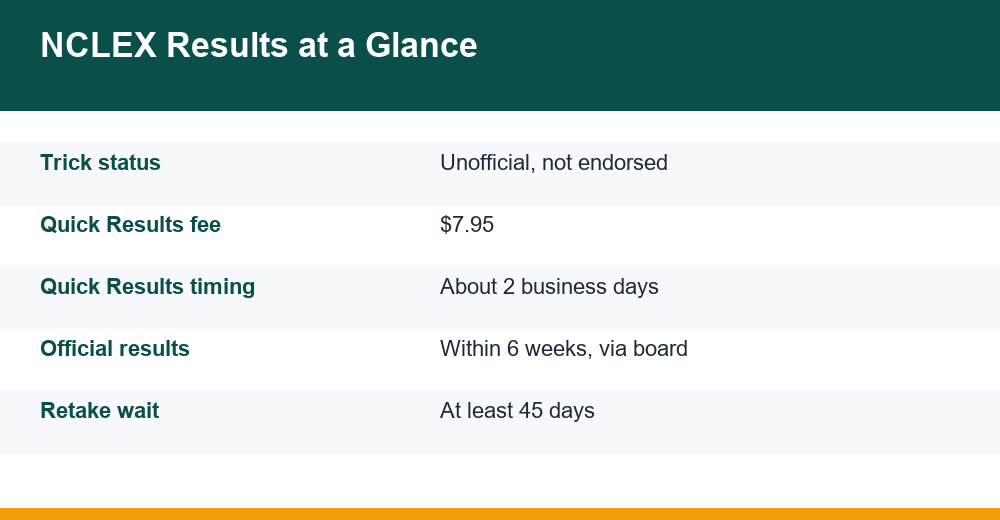
If you want an early answer that comes from the testing system itself, the legitimate option is the Quick Results Service. According to the official NCLEX Quick Results page, the fee is $7.95.
Unofficial results are typically available two business days after your exam. Weekends and holidays do not count, so a Friday test usually means waiting into the following week.
- Fee: $7.95, charged only if your results are available.
- Timing: roughly two business days after the exam.
- Eligibility: only if your board of nursing participates; not every jurisdiction does.
- Status: unofficial; it does not authorize practice.
How to get Quick Results
- Before test day, confirm on your board’s website or the NCLEX site that your board participates.
- After the waiting period, sign in to your Pearson VUE NCLEX account.
- Select the Quick Results option and pay the fee.
- Read the unofficial result, then keep watching for your board’s official notice.
An unofficial pass is good news, but it is still not permission to work. Treat it as a reason to relax, not as a reason to resign from a current job or tell an employer you are licensed.
How Long Official NCLEX Results Take
Official results come only from your nursing regulatory body. NCSBN states that boards send them to candidates within six weeks after the exam. Many boards are faster, especially when the rest of an application is already complete.
How you receive them depends on the board. Some post the outcome on an online license lookup, some email or mail a letter, and some do both. Your board’s website explains its own process, so check it before test day rather than guessing afterward.
Once a license is issued, it typically appears in public license records. You can verify a nursing license through your board’s lookup or Nursys, which is also what employers check before you start work.
Common reasons a result seems slow
- Missing transcripts or school verification.
- Fingerprint or background check results still pending.
- An incomplete or inconsistent application on the board’s side.
- Holiday periods and high-volume graduation months.
If six weeks pass with no word, contact your board directly. It is the only office that can see your full file and tell you what, if anything, is still missing.
What if you did not pass?
Candidates who fail receive a Candidate Performance Report. It shows how you performed across the test plan content areas, which makes it the most useful document you have for planning a retake.
Trick vs Quick Results vs Board Result
The three sources of information differ a lot in cost, speed and what they actually mean. This table sets them side by side.
| Feature | Pearson VUE trick | Quick Results | Board result |
|---|---|---|---|
| Who provides it | Nobody officially | Pearson VUE for NCSBN | Your board of nursing |
| Cost | Free | $7.95 | Part of licensure process |
| Timing | Hours to days, unreliable | About 2 business days | Within 6 weeks |
| Shows pass/fail directly | No, inferred from a pop-up | Yes, unofficial | Yes, official |
| Availability | Anyone can try it | Participating boards only | Every candidate |
| Authorizes practice | No | No | Only with an issued license |
The practical takeaway is simple. If waiting is unbearable, Quick Results is the honest early option where your board offers it. The free shortcut costs no money, but it can cost you peace of mind when the screen does not match reality.
What to Do While You Wait
The days after the NCLEX are hard. These steps keep you productive without relying on guesswork.
- Decide in advance whether to buy Quick Results, and confirm your board participates.
- Check your board’s website for how and when it posts results.
- Make sure your board application, fingerprints and transcripts are complete.
- Hold off on resigning from a current job or starting a nurse role until your license is issued.
- Avoid treating forum pop-up stories as proof of anything; they add stress, not facts.
If the official result is a fail, give yourself a few days before planning. NCSBN policy allows up to eight attempts a year with at least 45 days between attempts, though your board may set stricter limits. Our guide to retaking the NCLEX covers re-registration and how to use your performance report.
If it is a pass, you still need the license itself before working as an RN or PN. A pop-up on a website was never the finish line. The board-issued license is.
Frequently Asked Questions
Does the Pearson VUE trick really work?
Sometimes the pop-up matches the final result, but often it does not. It is not an official method from NCSBN, Pearson VUE or any board of nursing. Candidates report seeing the good pop-up and then failing, and the reverse. Treat it as a guess, and rely on Quick Results or your board’s official result for real answers.
How long after the NCLEX can you check the pop-up?
There is no official waiting time, because the trick is not an official process. Forum users commonly wait at least an hour, and many wait until the next day, since records take time to move from the test center to your board. Checking too early is a frequent reason people report a misleading screen.
How much are NCLEX Quick Results and when are they available?
Quick Results costs $7.95 and is charged only if your results are available. Unofficial results usually arrive about two business days after the exam, not counting weekends or holidays. The service works only if your board of nursing participates. It is an unofficial result and never authorizes you to practice as a nurse.
How long does it take to get official NCLEX results?
Official results come only from your nursing regulatory body, which sends them within six weeks of the exam. Many boards are quicker, especially when the rest of an application is complete. Delivery varies by board and may be an online license lookup, an email or a mailed letter. Check your board’s website.