A clear NCLEX study plan turns a daunting exam into a series of manageable weekly goals. This complete NCLEX study plan lays out a realistic six-week schedule — combining content review, heavy practice-question work, and honest self-assessment — that you can adjust to your own timeline. It works for both the NCLEX-RN and NCLEX-PN, because both reward the same thing: consistent practice and genuine understanding of clinical judgement.
Table of Contents
Why a study plan matters
The NCLEX is not a test you can cram for, because it measures judgement built up over time rather than facts memorised the night before. A plan matters because it forces steady daily progress, ensures every content area is covered, and builds the stamina needed for a five-hour adaptive exam. Just as importantly, a plan reduces anxiety: when you know exactly what to do each day, you spend your energy studying rather than worrying about whether you are studying the right things.
Before you start
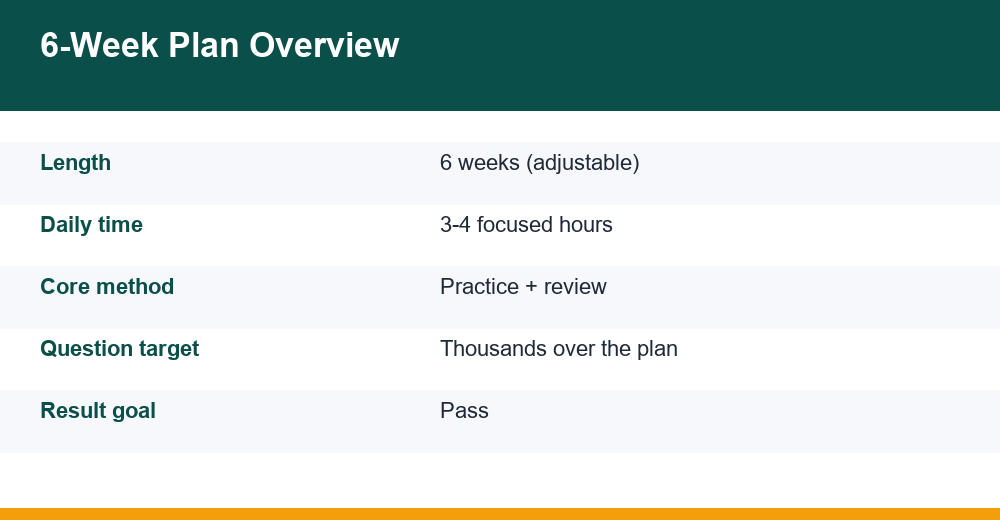
Two things make the plan work. First, choose one main question bank and one content resource and stick with them — switching constantly wastes time and breaks momentum. Second, take a short diagnostic practice test at the very beginning to find your weak areas, so your plan can prioritise them. Set a realistic daily commitment (three to four focused hours is typical for a full-time candidate) and protect that time. Understanding the exam first also helps; if you have not already, read our guide on what the NCLEX is.
The 6-week NCLEX study schedule
This schedule balances content review with a steadily rising volume of practice questions. Adjust the weeks to your own start point and exam date.
| Week | Focus | Practice goal |
|---|---|---|
| Week 1 | Fundamentals + your weakest area from the diagnostic | ~75 questions/day with full review |
| Week 2 | Physiological adaptation, pharmacology basics | ~100 questions/day |
| Week 3 | Management of care, safety, prioritisation & delegation | ~100 questions/day |
| Week 4 | Maternal-newborn, paediatrics, mental health | ~125 questions/day |
| Week 5 | Mixed comprehensive practice + Next Gen case studies | ~150 questions/day |
| Week 6 | Full-length practice tests, revision, light taper | 2-3 full tests + review |
Notice how the plan moves from content-led study early on to question-led study later. By the final week, you are mostly taking realistic practice tests and reviewing them, which is the best preparation for the real thing.
The role of practice questions
Practice questions are the heart of any NCLEX study plan. They do three things at once: they reveal gaps in your knowledge, they train you in the exam’s style of clinical-judgement questions (including the Next Generation case studies and bow-tie items), and they build the mental stamina the adaptive test demands. Aim to work through several thousand questions across the whole plan. Quality matters more than raw speed — a question you review thoroughly teaches far more than three you rush through.
How to review answers
The single most important habit is reviewing the rationale for every question — not just the ones you got wrong, but the ones you got right by guessing. For each question, ask why the correct answer is correct and, crucially, why each other option is wrong. This is how you turn isolated facts into the reasoning patterns the NCLEX rewards. Keep a running note of topics you repeatedly miss and feed them back into your content review. Over time, this review loop is what actually moves your score.
Judging your readiness
You are ready when three things are true: your practice-test performance is consistently at or above your question bank’s recommended passing benchmark, your weak areas from the diagnostic have clearly narrowed, and you can explain your reasoning on most questions rather than relying on recognition. If you are not there by the end of week six, it is far better to extend your plan by a week or two than to sit the exam unprepared. For related test-day guidance, see our other preparation guides, and confirm scheduling details with the official NCSBN.
Final tips
Consistency beats intensity: steady daily study with thorough question review will carry you further than occasional marathon sessions. Look after your sleep and health in the final week, because a rested mind performs far better on a five-hour exam. And ignore any offer of shortcuts, “guaranteed” passes or purchased certificates — they are frauds, and the only real route to a license is passing the exam yourself. Follow a plan like this honestly, and the NCLEX is very much within reach.
Frequently Asked Questions
How long should an NCLEX study plan be?
Six to eight weeks of focused study is realistic for most graduates, though it depends on your foundation. The key is consistency and heavy question practice, not the exact number of weeks.
How many practice questions should I do for the NCLEX?
Most successful candidates complete several thousand practice questions over their preparation, always reviewing the rationale for every question, correct or incorrect.
Is content review or practice questions more important?
Both matter, but practice questions with thorough review are the engine of NCLEX preparation, because they build the clinical judgement the exam tests. Use content review to fill the gaps the questions reveal.
How do I know if I am ready for the NCLEX?
Readiness shows when your practice-test scores are consistently at or above your question bank’s passing benchmark, your weak areas have narrowed, and you can explain why each answer is right or wrong.