NCLEX dosage calculations frighten many candidates, but they rely on just a few fixed formulas — master those and the questions become routine, scoring marks. This guide covers NCLEX dosage calculations with the essential formulas for oral doses, IV flow rates and weight-based dosing, each explained with a step-by-step worked example. Because medication math is a patient-safety skill, accuracy and a careful setup matter more than speed.
This guide is for study and revision only and may contain errors. Always follow your program, your drug reference and your facility protocols, and verify before acting.
Table of Contents
Why dosage calculations matter
Medication math is tested because a calculation error at the bedside can seriously harm a patient. On the exam, calculation items are usually fill-in-the-blank, so there are no options to guess from — you must produce the correct number. The good news is that the same handful of formulas covers almost every problem, so a little focused practice yields reliable marks and, more importantly, safe practice.
NCLEX dosage calculations: the formulas
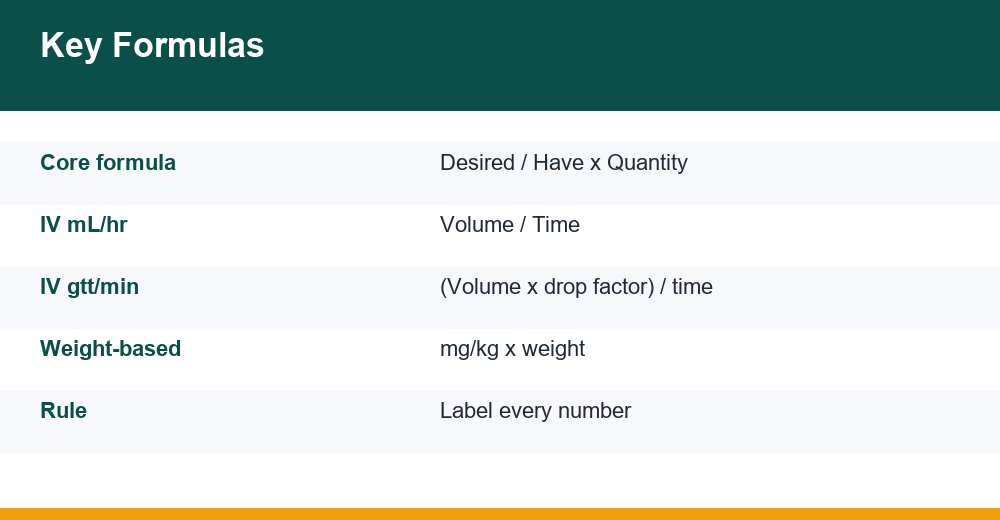
Four formulas cover the great majority of problems:
- Oral/injectable dose: Desired ÷ Have × Quantity (D/H × Q).
- IV flow rate (mL/hr): total Volume ÷ Time (in hours).
- IV drip rate (gtt/min): (Volume × drop factor) ÷ time (in minutes).
- Weight-based dose: dose (mg/kg) × patient weight (kg).
The single most important habit is to label every number with its unit and make sure the units cancel to leave the unit you want. This alone prevents most setup errors.
Oral dose examples
Example 1. The order is 500 mg; tablets are 250 mg each. How many tablets? Using D/H × Q: 500/250 × 1 = 2 tablets.
Example 2. The order is 0.125 mg; the liquid is 0.25 mg per 5 mL. How many mL? 0.125/0.25 × 5 = 2.5 mL.
IV flow rate examples
Example 3 (mL/hr). Infuse 1,000 mL over 8 hours. Rate = 1000/8 = 125 mL/hr.
Example 4 (gtt/min). Infuse 1,000 mL over 8 hours with a drop factor of 15 gtt/mL. First find mL/min (1000 ÷ 480 min = 2.083), then × 15 = about 31 gtt/min. (Equivalently, (1000 × 15) ÷ 480 = 31 gtt/min.)
Weight-based dosing
Example 5. The order is 5 mg/kg for a patient weighing 70 kg. Dose = 5 × 70 = 350 mg. Example 6. If that 350 mg must be given from a supply of 100 mg per mL, then 350/100 × 1 = 3.5 mL. Weight-based problems often combine two steps — first the dose, then the volume — so work them in order.
Tips to avoid errors
Label units and cancel them, keep decimal places accurate (a misplaced decimal is the classic dangerous error), and always ask whether the answer is reasonable — 25 tablets or 500 mL as an answer should make you recheck. Round only at the end and follow the rounding rule the question states. Practise a few calculation problems every day, because fluency here is a patient-safety skill as much as an exam skill. For related high-yield content, see our pharmacology guide, and confirm any drug detail against your reference. Official exam information is on the NCSBN website.
Frequently Asked Questions
What is the basic dosage calculation formula?
The core formula is Desired dose divided by dose on Hand, multiplied by the Quantity (D/H x Q). It works for most oral and injectable medication problems.
How do I calculate IV flow rate?
For mL/hr, divide the total volume by the time in hours. For drops per minute (gtt/min), multiply the volume by the drop factor and divide by the time in minutes.
Are dosage calculations hard on the NCLEX?
They are very learnable because they use a few fixed formulas. The key is to label your units, set up the formula carefully, and double-check the arithmetic.
How can I avoid dosage calculation errors?
Write down every number with its unit, cancel units to check your setup, keep decimals accurate, and ask whether the answer is reasonable for the patient.