NCLEX pharmacology intimidates many candidates, but it becomes manageable once you stop memorising individual drugs and start learning by class. This high-yield NCLEX pharmacology guide shows you the drug-class suffixes that predict a drug’s action, the high-alert medications the exam emphasises, the antidotes and therapeutic levels you must know, and a study method that works. Pharmacology is one of the largest content areas on the exam, so the effort pays off directly.
This guide is for study and revision only and may contain errors; reference ranges and drug information vary by source and laboratory. Always follow your program, your drug reference and your facility protocols, and verify critical values before acting.
Table of Contents
Why pharmacology matters
Pharmacology and parenteral therapies account for a large share of the NCLEX — commonly cited as around 12 to 18 percent of questions. More importantly, medication questions are where safe practice is tested most directly: recognising a dangerous side effect, holding a drug for an abnormal lab value, or identifying a high-alert medication that needs a double-check. Because there are far too many individual drugs to memorise, the winning strategy is to learn the classes and the patterns, so you can reason about any drug you meet.
Drug-class suffixes that give the answer away
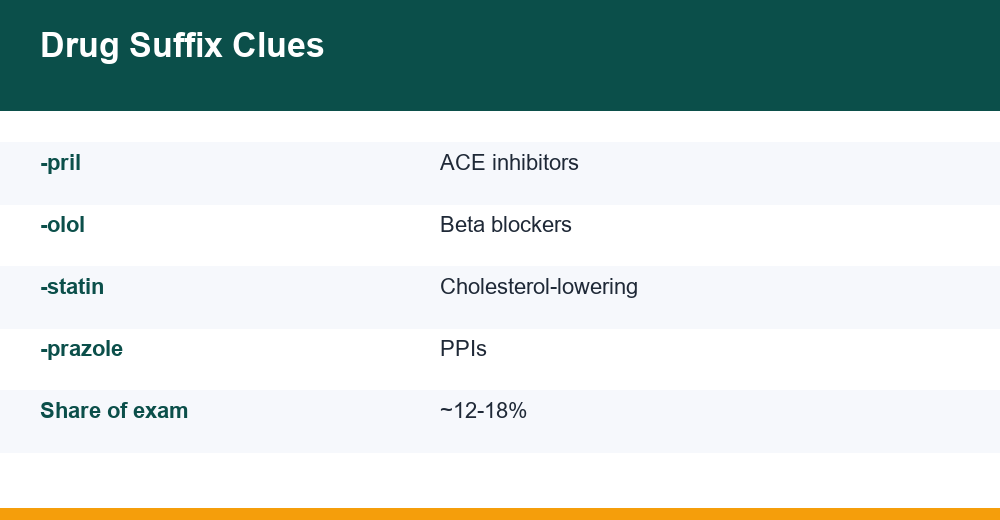
Most drugs in a class share a common ending, and that ending tells you the class, the action and the likely side effects. Learning these suffixes is the single most efficient thing you can do for NCLEX pharmacology.
| Suffix | Drug class | Used for |
|---|---|---|
| -pril | ACE inhibitors | Hypertension, heart failure (watch dry cough, hyperkalemia) |
| -sartan | ARBs | Hypertension (alternative to ACE inhibitors) |
| -olol | Beta blockers | Hypertension, angina (hold for low HR/BP) |
| -dipine | Calcium channel blockers | Hypertension, angina |
| -statin | Statins | High cholesterol (watch muscle pain, liver) |
| -prazole | Proton pump inhibitors | GERD, ulcers |
| -pam / -lam | Benzodiazepines | Anxiety, sedation (CNS depression) |
| -cillin | Penicillin antibiotics | Infection (watch allergy) |
| -floxacin | Fluoroquinolone antibiotics | Infection (tendon rupture risk) |
| -mycin | Aminoglycoside/macrolide antibiotics | Infection (ototoxicity/nephrotoxicity for -amicin) |
High-alert medications
High-alert medications are those most likely to cause serious harm when used in error, so the NCLEX tests them heavily. The classic trio is insulin, heparin and other anticoagulants, and opioids. For these, know the safety practices: independent double-checks for insulin and heparin infusions, monitoring the relevant labs (glucose for insulin, aPTT for heparin, INR for warfarin), and monitoring respiratory status and having the antidote available for opioids. Concentrated electrolytes such as intravenous potassium chloride are also high-alert and must never be given by rapid IV push.
Antidotes you must know
Antidote questions are direct and scoring if you have memorised the pairs:
| Drug / toxin | Antidote |
|---|---|
| Warfarin | Vitamin K |
| Heparin | Protamine sulfate |
| Opioids | Naloxone (Narcan) |
| Benzodiazepines | Flumazenil |
| Acetaminophen | Acetylcysteine |
| Digoxin | Digoxin immune Fab |
| Magnesium sulfate | Calcium gluconate |
Therapeutic drug levels
Narrow-therapeutic-index drugs must be kept within a tight range, and the NCLEX expects you to know the numbers and the signs of toxicity. Digoxin is therapeutic at 0.5-2.0 ng/mL (toxicity causes nausea, visual changes and arrhythmias); lithium at 0.6-1.2 mEq/L (toxicity causes tremor, confusion and GI upset); and phenytoin at 10-20 mcg/mL. For any of these, checking the level is often the correct first action. These overlap with our NCLEX lab values cheat sheet.
Medication safety principles
Beyond specific drugs, the NCLEX tests the principles of safe administration: the “rights” of medication administration (right patient, drug, dose, route, time and documentation), checking allergies, using two patient identifiers, and never giving a medication you did not prepare. When a question offers several plausible actions, the safest option — assessing the patient, verifying an order, or holding a drug for an abnormal value — is usually correct. This safety-first mindset is the thread running through all NCLEX pharmacology questions.
How to study NCLEX pharmacology
Study by class, not by individual drug: learn the suffix, the prototype drug, the action, the major side effects and the key nursing consideration for each class. Layer the high-alert medications, antidotes and therapeutic levels on top, since these are direct, scoring facts. Then drill practice questions so you see the drugs inside patient scenarios. Pair this with our NCLEX study plan and guide to NCLEX question types, and always confirm drug details against a current reference — this guide is for study only. Official exam information is available on the NCSBN website.
Frequently Asked Questions
How much of the NCLEX is pharmacology?
Pharmacology and parenteral therapies make up a substantial share of the NCLEX — roughly 12-18% of questions — so it is one of the most important areas to master.
What is the easiest way to learn NCLEX pharmacology?
Learn drugs by class using their common suffixes (for example -pril for ACE inhibitors, -olol for beta blockers), which lets you predict the action and side effects of unfamiliar drugs.
What are high-alert medications on the NCLEX?
High-alert medications carry a heightened risk of harm if used in error — insulin, heparin and other anticoagulants, and opioids are the classic examples the NCLEX emphasises.
Do I need to memorize every drug for the NCLEX?
No. Focus on drug classes, their suffixes, high-alert medications, key antidotes and narrow-therapeutic-index drugs rather than memorising hundreds of individual drug names.