For internationally educated nurses, the path to a US license involves more than the exam itself — and understanding the NCLEX for international nurses process from the start prevents costly delays. The good news is that the exam is exactly the same as for US graduates; the difference is a set of extra steps beforehand: credential evaluation, English proficiency, and authorization by a board of nursing. This complete guide explains each step so international nurses (IENs) can plan the whole journey. Requirements vary by state, so always confirm with your chosen board of nursing.
Table of Contents
The exam is the same
There is one NCLEX-RN and one NCLEX-PN, and it is identical for everyone — the same computer-adaptive format, the same Next Generation item types, the same pass/fail result. What differs for internationally educated nurses is the front end: before you can be authorised to test, you must prove that your education and English meet US standards. So the study preparation is the same as for any candidate; it is the eligibility process that has extra steps.
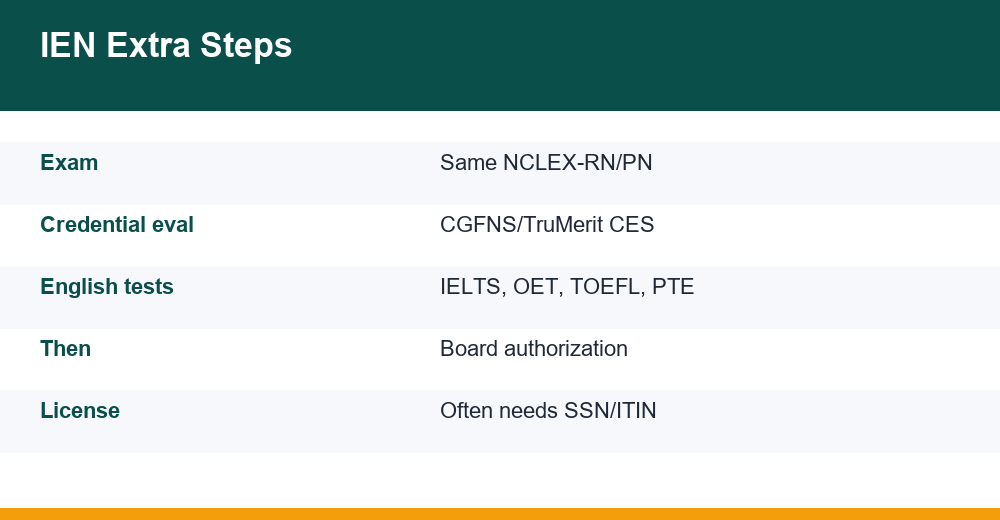
NCLEX for international nurses: the extra steps
- Choose the state where you want to be licensed and check its specific IEN requirements.
- Complete a credential evaluation to verify your nursing education against US standards.
- Meet the English proficiency requirement (unless exempt).
- Apply to the board of nursing and complete background checks.
- Register with Pearson VUE, obtain your ATT and take the NCLEX.
- Complete any post-exam licensing steps, which may require an SSN or ITIN.
Credential evaluation
Most boards of nursing require a Credentials Evaluation Service (CES) report that confirms your nursing degree is comparable to a US nursing education. This is most commonly obtained through CGFNS International — which rebranded as TruMerit — or another agency the board accepts. The report reviews your education, licensure in your home country and, sometimes, your registration. Because gathering transcripts and verifications from overseas institutions takes time, start this step early; it is often the longest part of the whole process.
English proficiency
If your nursing education was not conducted in English, you will usually need to pass an approved English proficiency test. Commonly accepted options include IELTS Academic, OET (Nursing), TOEFL iBT and PTE Academic. Minimum scores vary from board to board, and some boards waive the requirement entirely if your program was taught in English or you trained in certain countries. Check your target board’s exact test list and score thresholds before booking a test, so you sit the right one at the right level.
Board authorization & the SSN question
You cannot schedule the NCLEX until a board of nursing has authorised you, so board authorization is the gateway to the exam. Alongside credential evaluation and English proficiency, expect a criminal background check and fingerprinting. A common point of confusion is the Social Security Number: most boards do not require an SSN merely to sit the exam, but many require an SSN or an Individual Taxpayer Identification Number (ITIN) before they will issue the license. If you plan to work in the US, factor this into your timeline early.
Preparing for the exam
Once the eligibility steps are underway, prepare exactly as any candidate would — there is no separate “international” version to study. Focus on clinical judgement, the Next Generation item types, and the high-yield content areas. International nurses sometimes find US-specific practices (delegation rules, documentation, certain medication names) unfamiliar, so pay particular attention to those. Our NCLEX study plan, prioritization and delegation guide and lab values cheat sheet are good starting points.
Key takeaways
The NCLEX for international nurses is the same exam with extra eligibility steps: credential evaluation, English proficiency and board authorization, often followed by an SSN/ITIN requirement to obtain the license. Start the credential evaluation early, confirm your specific board’s rules, and beware anyone claiming to sell a shortcut — a US nursing license can only be earned by passing the NCLEX, as we explain in how to verify a nursing license. Authoritative guidance for IENs is on the NCSBN website.
Frequently Asked Questions
Is the NCLEX different for international nurses?
No. The NCLEX-RN and NCLEX-PN are identical for US-educated and internationally educated nurses. The difference is the extra steps international nurses complete before the exam — credential evaluation, English proficiency and board authorization.
What credential evaluation do international nurses need?
Most boards require a Credentials Evaluation Service (CES) report to confirm your nursing education matches US standards. This is commonly obtained from CGFNS, which rebranded as TruMerit, or another approved agency.
Which English tests are accepted for the NCLEX?
Commonly accepted English proficiency tests include IELTS Academic, OET (Nursing), TOEFL iBT and PTE Academic. Minimum scores vary by board, and some boards waive the requirement if your program was taught in English.
Do international nurses need an SSN for the NCLEX?
Most boards do not require a Social Security Number just to sit the exam, but many require an SSN or ITIN before issuing the license, so plan for this in advance.