
Memorizing NCLEX lab values is one of the highest-return things you can do, because the exam rarely asks for a number on its own — it asks what a nurse should do when a value is abnormal. This complete NCLEX lab values cheat sheet gives you the normal ranges and the critical values for electrolytes, blood counts, coagulation, arterial blood gases and therapeutic drug levels, along with what each abnormality means for patient care.
This guide is for study and revision only and may contain errors; reference ranges and drug information vary by source and laboratory. Always follow your program, your drug reference and your facility protocols, and verify critical values before acting.
Table of Contents
Why lab values matter on the NCLEX
The Next Generation NCLEX tests clinical judgement, and lab values are a constant source of the “cues” you must recognise and act on. A potassium of 6.8 is not just a number; it is a cardiac emergency. A platelet count of 30,000 changes your entire plan of care around bleeding precautions. Because of this, the goal is not only to memorise the range but to know, for every important value, what a high or low result causes and what the nurse does first. Learn the numbers as triggers for action and the questions become far easier.
Electrolytes
Electrolytes are the most frequently tested lab values, and potassium is the single most important because of its effect on the heart.
| Electrolyte | Normal range | Watch for |
|---|---|---|
| Sodium | 135-145 mEq/L | Neuro changes; low sodium causes confusion/seizures |
| Potassium | 3.5-5.0 mEq/L | Cardiac arrhythmias at both extremes |
| Calcium | 9.0-10.5 mg/dL | Tetany when low; Chvostek/Trousseau signs |
| Magnesium | 1.5-2.5 mEq/L | Cardiac and neuromuscular effects |
| Chloride | 98-106 mEq/L | Moves with sodium and acid-base status |
| Phosphorus | 3.0-4.5 mg/dL | Inverse relationship with calcium |
Blood counts & coagulation
Blood counts guide infection, oxygenation and bleeding-risk decisions; coagulation values guide anticoagulant therapy.
| Test | Normal range | Notes |
|---|---|---|
| WBC | 5,000-10,000 /mm3 | High suggests infection; low raises infection risk |
| Hemoglobin | 12-18 g/dL (sex-dependent) | Low indicates anemia |
| Hematocrit | 37-52% (sex-dependent) | Roughly three times the hemoglobin |
| Platelets | 150,000-400,000 /mm3 | Below 50,000 = bleeding risk |
| INR | 0.8-1.1 (2.0-3.0 on warfarin) | Monitors warfarin; reverse with vitamin K |
| aPTT | 30-40 sec (1.5-2.5x on heparin) | Monitors heparin; reverse with protamine |
Arterial blood gases (ABGs)
ABGs are a classic NCLEX topic. Learn the normal ranges, then practise the “ROME” approach — Respiratory Opposite, Metabolic Equal — to interpret acid-base disorders.
| ABG value | Normal range |
|---|---|
| pH | 7.35-7.45 |
| PaCO2 | 35-45 mmHg |
| HCO3 (bicarbonate) | 22-26 mEq/L |
| PaO2 | 80-100 mmHg |
A low pH is acidosis and a high pH is alkalosis. If the PaCO2 moves opposite to the pH, the cause is respiratory; if the HCO3 moves in the same direction as the pH, the cause is metabolic. This single framework answers most ABG questions.
Therapeutic drug levels
Narrow-therapeutic-index drugs appear repeatedly, because a level just outside the range can be dangerous. When one of these drugs is in a question, check the level first.
| Drug | Therapeutic level |
|---|---|
| Digoxin | 0.5-2.0 ng/mL |
| Lithium | 0.6-1.2 mEq/L |
| Phenytoin (Dilantin) | 10-20 mcg/mL |
| Therapeutic INR (warfarin) | 2.0-3.0 |
Critical values that demand action
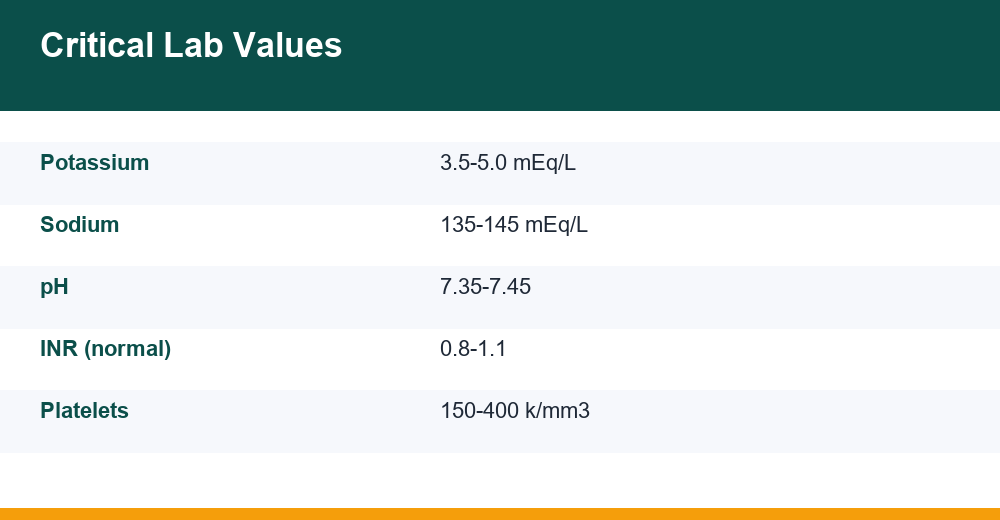
Critical values are so far outside normal that they require immediate nursing action and provider notification. While exact thresholds vary by facility, commonly cited critical values include potassium below 2.5 or above 6.5 mEq/L, sodium below 120 or above 160 mEq/L, glucose below 40 or above 500 mg/dL, platelets below 20,000, and an INR above 5. On the exam, recognising a critical value and choosing the correct first action — often assess the patient and notify the provider — is exactly the clinical judgement being measured.
How to memorize NCLEX lab values
Group the values by system rather than learning a random list, and for each one pair the range with a cause and an action (“low potassium → arrhythmia → monitor ECG, replace cautiously”). Focus your energy on the highest-yield values — the electrolytes, ABGs, coagulation studies and narrow-index drugs above. Then reinforce them with practice questions, because seeing the value inside a patient scenario is how the NCLEX actually tests it. Combine this with our NCLEX pharmacology guide and NCLEX study plan, and confirm ranges against your own drug reference. Authoritative exam information is on the NCSBN website.
Frequently Asked Questions
What lab values do I need to know for the NCLEX?
Focus on electrolytes (sodium, potassium, calcium, magnesium), blood counts (WBC, hemoglobin, hematocrit, platelets), coagulation (INR, aPTT), arterial blood gases (pH, PaCO2, HCO3, PaO2) and therapeutic drug levels (digoxin, lithium). These drive nursing actions.
What is the normal range for potassium?
The normal serum potassium range is about 3.5-5.0 mEq/L. Values outside this range affect the heart, so potassium is one of the most important lab values on the NCLEX.
What are critical lab values?
Critical values are results so abnormal they require immediate action — for example potassium below 2.5 or above 6.5 mEq/L, sodium below 120 or above 160, or glucose below 40 or above 500 mg/dL. Exact thresholds vary by facility.
How do I memorize lab values for the NCLEX?
Group them by system, learn the normal range and what a high or low value causes, and practise questions that ask for the nursing action rather than just the number.