
NCLEX prioritization and delegation questions are among the most challenging on the exam, because every option often looks correct — the real test is deciding what comes first and who can safely do what. This guide gives you the frameworks and rules that make these questions systematic: ABC and Maslow for prioritization, the five rights for delegation, and clear guidance on what to assign to a UAP, an LPN/LVN or an RN.
Table of Contents
Why NCLEX prioritization and delegation questions are hard
Prioritization and delegation questions are designed so that several answers describe something a nurse legitimately should do. Choosing correctly is not about knowing more facts; it is about applying a consistent decision framework under pressure. Answer these questions in an “ideal” world — imagine you have the staff, supplies and time you need — rather than basing decisions on shortcuts you may have seen in clinical practice. With the frameworks below, the “which comes first” question stops being guesswork.
Prioritization frameworks
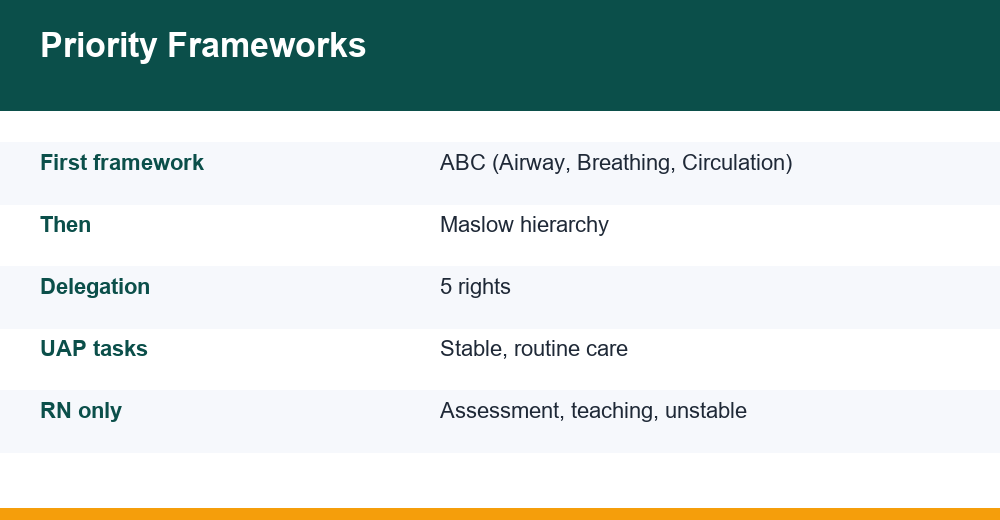
Two frameworks answer most prioritization questions. First, ABC — Airway, Breathing, Circulation: a threat to the airway always outranks a breathing problem, which outranks a circulation problem. Second, Maslow’s hierarchy of needs: physiological needs (oxygen, fluid, nutrition, elimination) come before safety, which comes before psychosocial needs. When ABC does not settle a question, Maslow usually does. A physical, physiological problem generally takes priority over an emotional or educational one.
Priority decision rules
Layer these rules on top of ABC and Maslow:
- Acute over chronic — a new, acute problem outranks a stable chronic condition.
- Unstable over stable — the deteriorating patient is seen first.
- Actual over potential — an existing problem outranks a risk, unless the risk is life-threatening.
- Unexpected over expected — a new or unexpected finding is more concerning than an expected one for a known condition.
- Assessment first — when unsure, gathering more assessment data is often the correct first action.
The five rights of delegation
Delegation questions turn on the five rights of delegation: the right task, the right circumstance, the right person, the right direction and communication, and the right supervision. The RN remains accountable for the outcome, so a task can only be delegated when it is within the receiver’s scope and the patient situation is appropriate. If any of the five rights is missing, the delegation is unsafe.
What to delegate to whom
A reliable rule of thumb: the RN keeps anything that requires nursing judgement — assessment, teaching, evaluation, care planning and unstable patients — while more routine, stable tasks can be delegated.
| Role | Can typically do | Cannot do |
|---|---|---|
| UAP (nursing assistant) | Bathing, feeding, ambulating, routine vitals, intake/output | Assessment, teaching, evaluation, meds (generally) |
| LPN/LVN | Stable patients, many medications, routine care, data collection | Initial assessment, IV push (varies), care planning, teaching |
| RN | Assessment, teaching, evaluation, unstable patients, care planning | — |
Worked examples
Example 1. Four patients need attention: one with new shortness of breath, one due for a routine dressing change, one requesting pain medication, and one asking for discharge teaching. Who is seen first? The patient with shortness of breath — a breathing problem under ABC takes priority.
Example 2. Which task can the RN delegate to a UAP: assessing a new admission, teaching insulin injection, assisting a stable patient to the bathroom, or evaluating a wound? Assisting a stable patient to the bathroom — the others require nursing judgement and cannot be delegated.
Key takeaways
Approach every prioritization question with ABC first, then Maslow, then the acute/unstable rules. Approach every delegation question with the five rights and the principle that assessment, teaching, evaluation and unstable patients stay with the RN. Practise these until the reasoning is automatic, because these questions are guaranteed to appear. Combine this with our guide to NCLEX question types and study plan, and see the official exam blueprint on the NCSBN website.
Frequently Asked Questions
What framework should I use for NCLEX prioritization?
Start with ABC — Airway, Breathing, Circulation — then use Maslow’s hierarchy (physiological needs before psychosocial), and prioritise acute over chronic and unstable over stable patients.
What are the five rights of delegation?
The five rights of delegation are the right task, the right circumstance, the right person, the right direction/communication, and the right supervision.
What can be delegated to a UAP?
Unlicensed assistive personnel can perform stable, routine tasks such as bathing, feeding, ambulating, and taking routine vital signs — never assessment, teaching, evaluation or care of an unstable patient.
Why are prioritization questions difficult?
Because several options may all be things a nurse should do; the test is deciding what to do first, which patient can safely wait, and which task can be safely assigned to another team member.