
Mastering the NCLEX priority frameworks is the key to one of the exam’s hardest question types: the “what does the nurse do first” question, where several options all look correct. This guide explains the NCLEX priority frameworks — ABC, Maslow, the nursing process and the acute/unstable rules — and, crucially, the order in which to apply them, so you can answer priority questions systematically instead of guessing.
Table of Contents
Why priority questions matter
Priority questions are everywhere on the NCLEX, and they are central to the Next Generation case studies, where you must prioritise hypotheses and take action. They are hard because the wrong options are usually things a nurse legitimately should do — just not first. Frameworks solve this by giving you a consistent way to rank actions, so your answer is based on a rule rather than a hunch. Learn the frameworks and their order, and these questions become some of the most reliable on the exam.
NCLEX priority frameworks explained
There are a few core frameworks, and they work together in a definite sequence: ABC for life-threatening physical priorities, Maslow for ranking human needs, the nursing process for deciding whether to assess or act, and supporting rules such as acute-over-chronic and unstable-over-stable. The skill is knowing which to reach for and in what order, which the sections below make concrete.
ABC: airway, breathing, circulation
ABC is always your first filter. A threat to the airway outranks everything, because without an airway nothing else matters; a breathing problem comes next; then circulation (bleeding, perfusion, cardiac output). When a question offers several patients or actions, scan first for an airway threat, then breathing, then circulation. Many priority questions are answered by ABC alone. Some frameworks extend this to “ABCs then D” for disability/neuro, but ABC is the core.
Maslow: physiological needs first
When ABC does not settle the question — for example when no option is a direct airway, breathing or circulation threat — apply Maslow’s hierarchy of needs. Physiological needs (oxygen, food, fluid, elimination, rest, pain relief) come before safety needs, which come before psychosocial needs such as love, esteem and self-actualisation. In practice this means a physical need generally outranks an emotional or educational one. Maslow resolves most of the priority questions that ABC does not.
The nursing process (ADPIE)
The nursing process — Assessment, Diagnosis, Planning, Implementation, Evaluation (ADPIE) — guides whether to gather more information or to act. A key exam principle is assess before you act: when a question asks what to do first and one option is to assess or collect more data, that is frequently the correct answer, because you should understand the situation before intervening. The exception is a clear emergency, where an established intervention (such as a life-saving action under ABC) takes precedence over further assessment.
Putting the frameworks in order
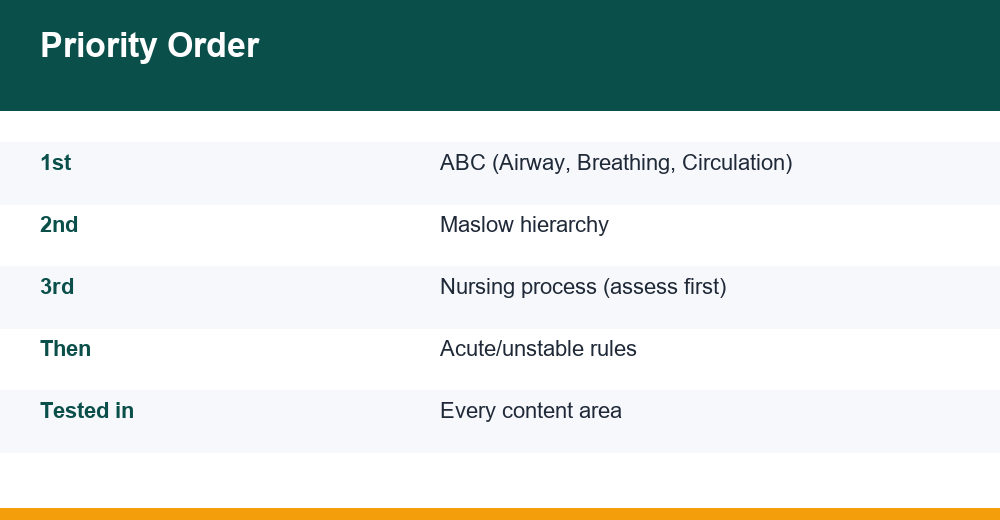
Apply the frameworks in this sequence: ABC first, then Maslow, then the nursing process (assess vs act), then the supporting rules — acute over chronic, unstable over stable, and actual over potential problems (unless a potential problem is life-threatening). Walking a question through this order almost always produces a single, defensible first action. The full application to delegation is covered in our prioritization and delegation guide.
Key takeaways
The NCLEX priority frameworks — ABC, Maslow, the nursing process and the acute/unstable rules — turn intimidating “what comes first” questions into systematic decisions. Apply them in order, starting with ABC, and practise until the sequence is automatic, because these questions appear throughout the exam and especially in the Next Generation case studies covered in our NGN guide. For the exam blueprint, see the NCSBN website.
Frequently Asked Questions
What are the NCLEX priority frameworks?
They are decision tools for answering “what does the nurse do first” questions — chiefly ABC (Airway, Breathing, Circulation), Maslow’s hierarchy of needs, and the nursing process (assess first), plus acute-over-chronic and unstable-over-stable rules.
Which framework do I use first?
Apply ABC first — a threat to airway, then breathing, then circulation always takes priority. If ABC does not resolve the question, apply Maslow, then the nursing process.
What is the nursing process order?
ADPIE: Assessment, Diagnosis, Planning, Implementation, Evaluation. On the exam, when unsure, gathering more assessment data is often the correct first action.
Do priority frameworks appear throughout the NCLEX?
Yes. Priority and “first action” questions appear across every content area and are especially central to the Next Generation case studies.