Infection control is a guaranteed NCLEX topic, because preventing the spread of infection is a core patient-safety duty. This guide covers the essentials for the NCLEX — standard precautions, the three types of transmission-based precautions (contact, droplet and airborne), the correct PPE and the diseases that go with each — in a way you can quickly memorise. Getting the precaution type right for a given disease is exactly what the exam tests.
This guide is for study and revision only and may contain errors. Always follow your program, your drug reference and your facility protocols, and verify before acting.
Table of Contents
Why it matters
Infection prevention sits within the “safe and effective care environment” area of the test plan and appears throughout the exam. Questions typically give a patient with a specific infection and ask which precautions or PPE the nurse should use, or which action prevents transmission. Because the categories are finite and rule-based, this is high-yield, learnable content — and, of course, it reflects a duty that protects real patients.
Standard precautions
Standard precautions apply to the care of every patient, regardless of diagnosis, because you cannot always know who is infectious. They include hand hygiene before and after every patient contact, using gloves when touching body fluids, wearing appropriate PPE for anticipated exposure, safe handling and disposal of sharps, and respiratory hygiene. Hand hygiene is the single most important infection control measure and the foundation of everything else.
Infection control precautions for the NCLEX
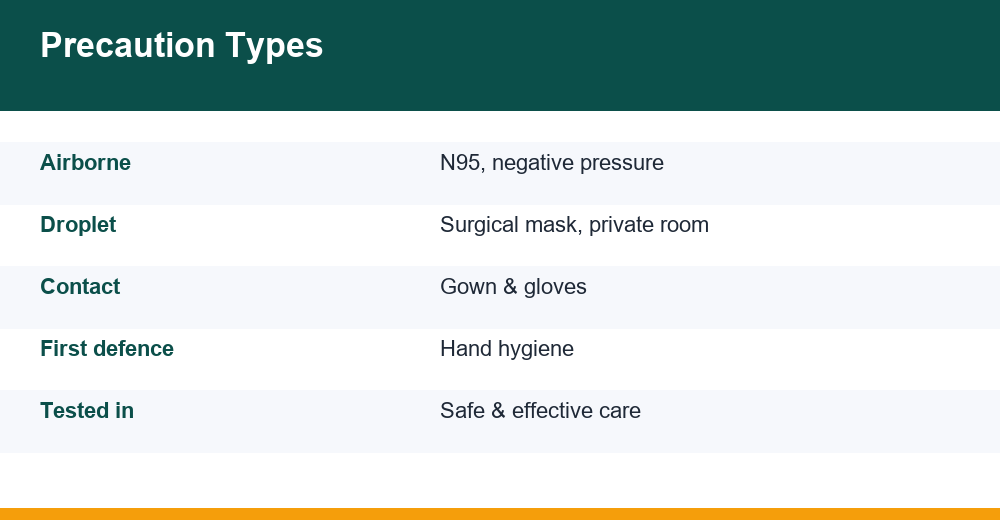
On top of standard precautions, three transmission-based categories apply to specific organisms:
| Precaution | PPE / setup | Spread by |
|---|---|---|
| Contact | Gown and gloves; dedicated equipment | Direct or indirect touch |
| Droplet | Surgical mask; private room (or spacing) | Large respiratory droplets |
| Airborne | N95 respirator; negative-pressure room | Small airborne particles |
PPE and the order
Know the correct sequence for putting on and removing PPE, which is a common question. To don (put on): gown, then mask/respirator, then goggles, then gloves. To doff (remove): gloves, then goggles, then gown, then mask — removing the most contaminated items first and the mask last, outside the room where appropriate. Hand hygiene is performed after removing all PPE. Getting this order right protects both nurse and patient.
Disease examples by precaution
Matching the disease to the precaution is the crux of most questions. A useful memory aid for airborne is that measles (rubeola), tuberculosis and varicella (chickenpox) require airborne precautions with an N95 and negative pressure. Droplet precautions cover influenza, pertussis (whooping cough), mumps and bacterial meningitis, needing a surgical mask and a private room. Contact precautions cover MRSA, VRE and C. difficile, needing gown and gloves — and remember that C. difficile requires hand washing with soap and water, because alcohol-based sanitiser does not kill its spores.
Key takeaways
For infection control on the NCLEX, learn standard precautions as the baseline for all patients, then memorise the three transmission-based categories with their PPE and signature diseases, and know the don/doff order. Keep hand hygiene at the centre of every answer. Combine this with our prioritization guide and cram sheet for exam day, and see the official test plan on the NCSBN website.
Frequently Asked Questions
What are the types of transmission-based precautions?
There are three types: contact precautions (for organisms spread by touch, such as MRSA and C. difficile), droplet precautions (for influenza, pertussis, meningitis) and airborne precautions (for tuberculosis, measles and varicella).
What PPE is needed for airborne precautions?
Airborne precautions require an N95 respirator and a negative-pressure isolation room, in addition to standard precautions.
Which precautions are used for C. difficile?
Contact precautions with gown and gloves, and hand hygiene with soap and water rather than alcohol-based sanitiser, because spores are not killed by alcohol.
What is the most important infection control measure?
Hand hygiene is the single most important measure to prevent the spread of infection, and it underlies all standard and transmission-based precautions.