Knowing the NCLEX question types in advance means nothing on the screen surprises you on exam day. This guide explains every NCLEX question type — from the classic multiple-choice and select-all-that-apply items to the Next Generation formats like bow-tie, matrix and cloze — and gives you a clear approach for each. Familiarity with the formats lets you spend your energy on the clinical thinking, not on figuring out how to answer.
Table of Contents
NCLEX question types: the full list
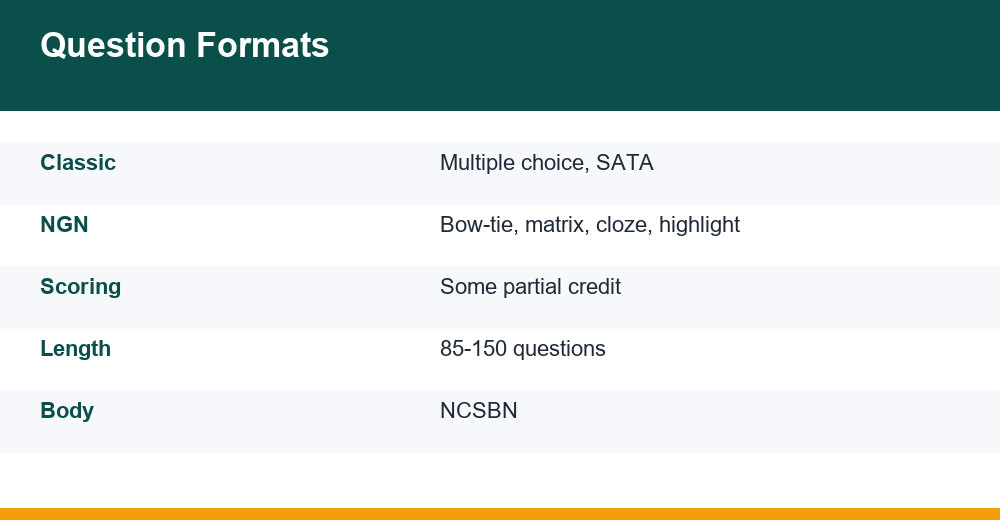
The exam mixes traditional items with the newer formats introduced by the Next Generation NCLEX in 2023. Broadly, you will meet classic multiple-choice and select-all-that-apply questions, plus a family of NGN formats designed to test the six steps of clinical judgement. Each format is just a different way of asking you to recognise cues, analyse them, prioritise, act and evaluate — so the thinking is the same even when the layout changes.
Classic formats
The multiple-choice question asks for the single best answer from four options and remains the backbone of the exam. Note the emphasis on best: often more than one option is correct, and your job is to choose the priority action. Older “alternate formats” also appear, such as fill-in-the-blank calculations (see our dosage calculations guide), ordered-response (drag to rank) items, and hot-spot questions where you click a location on an image.
Next Generation formats
The NGN formats are the newest and most distinctive. The bow-tie item links a condition, the actions to take and the parameters to monitor in one integrated question. The trend item asks you to interpret how a patient’s data changes over time. Matrix/grid items have you mark options across a table, cloze items complete sentences from drop-down menus, and highlight items ask you to click the relevant words in a passage. Our Next Generation NCLEX guide covers these in depth.
Select all that apply (SATA)
Select-all-that-apply questions ask you to choose every correct option, and they intimidate candidates because there is no fixed number of answers. The reliable method is to treat each option as its own true/false question: for each one, ask “is this correct for this patient, yes or no?” independently of the others. Under the Next Generation scoring, many extended multiple-response items award partial credit, so answer every option thoughtfully rather than leaving the item.
How to approach each type
Across all formats, the underlying strategy is the same: read the scenario, identify what is actually being asked, and apply clinical judgement rather than pattern-matching. For prioritisation-style items, use the ABC and Maslow frameworks from our prioritization and delegation guide. For calculation items, show your work. For NGN case studies, move deliberately through the six-step judgement model. The format determines how you enter your answer; the nursing reasoning determines whether it is correct.
Key takeaways
There is no need to fear any NCLEX question type once you have practised it. Expose yourself to every format before exam day using an NGN-ready question bank, treat SATA options individually, and take advantage of partial credit. Combine this with our NCLEX study plan, and see the official item-type descriptions on the NCSBN website. Master the formats, and the exam becomes purely a test of your nursing judgement.
Frequently Asked Questions
What question types are on the NCLEX?
The NCLEX includes classic multiple-choice and select-all-that-apply questions plus Next Generation formats such as extended multiple response, matrix/grid, cloze (drop-down), highlight, drag-and-drop, bow-tie and trend items.
What is a select-all-that-apply (SATA) question?
A SATA question asks you to choose every correct option from a list. Treat each option as a separate true/false decision, and remember that many NGN versions award partial credit.
Are NCLEX questions all multiple choice?
No. While multiple choice remains common, the Next Generation NCLEX added several new interactive formats designed to measure clinical judgment.
Do NCLEX question types have partial credit?
Many Next Generation item types use partial-credit scoring, so answering every element carefully is worthwhile even if you are unsure of one part.