
Understanding why candidates fail NCLEX is the fastest way to make sure you do not. Most fails come down to a small set of avoidable preparation mistakes, not a lack of ability. This guide walks through the seven most common reasons candidates fail the NCLEX and the practical fix for each — so whether you are preparing for a first attempt or a retake, you can sidestep the traps that catch so many.
Table of Contents
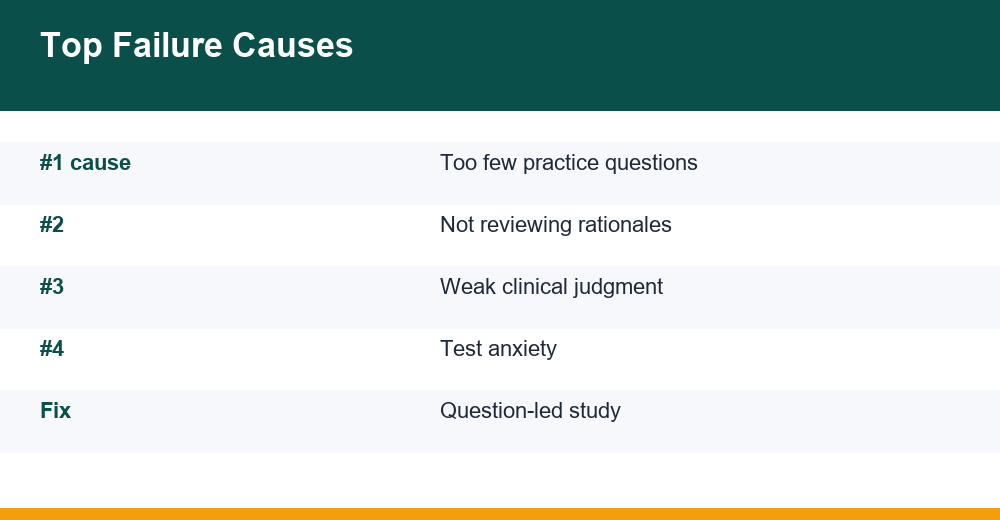
Why candidates fail NCLEX: the top reasons
The NCLEX is challenging, but the reasons people fail are remarkably consistent. They cluster around how candidates studied rather than how hard they worked — and that is good news, because how you study is entirely within your control. Recognising which of these patterns applied to you (or might) turns a vague fear of failing into a specific, fixable checklist.
The 7 common reasons
- Too few practice questions — leaning on reading instead of doing.
- Not reviewing rationales — checking the answer but not learning why.
- Memorising facts, not building judgment — the exam tests decisions.
- Poor time management — running low on stamina over a long adaptive exam.
- Under-preparing for Next Generation items — being surprised by NGN formats.
- Ignoring weak areas — studying what is comfortable, not what is needed.
- Test anxiety — letting nerves undermine real knowledge.
Too few practice questions
The most common reason candidates fail is relying on passive content review while doing too few practice questions. Reading notes feels productive, but it does not build the decision-making the NCLEX measures. The fix is to make practice questions the centre of your preparation — thousands of them across your study period — using content review only to fill the gaps the questions reveal. Our NCLEX study plan is built around exactly this question-led approach.
Studying facts, not judgment
Closely related is studying to recall facts rather than to make clinical decisions. The Next Generation NCLEX is explicitly designed to test judgement — recognising cues, prioritising, acting and evaluating — so a candidate who can recite facts but cannot apply them will struggle. The fix is to practise reasoning through patient scenarios and to review why each option is right or wrong, which trains the judgement the exam rewards. The prioritization frameworks are especially useful here.
Test anxiety and timing
Two performance factors round out the list. Test anxiety can sabotage a well-prepared candidate by impairing focus and second-guessing, and it is best countered by genuine confidence from preparation plus familiarity with how NCLEX scoring works so the exam-day unknowns feel smaller. Time management matters because the exam can run to 150 questions over five hours; practising full-length, timed tests builds the stamina and pacing that prevent a late-exam collapse.
Turning fails into fixes
If you have already failed, your Candidate Performance Report tells you which content areas were below standard, so you can target them precisely — see our guide to retaking the NCLEX. If you are preparing for a first attempt, simply audit yourself against the seven reasons above and adjust before they become problems. Either way, the fixes are concrete and proven: more practice, deeper review, judgement-focused study, timed simulation, and managed anxiety.
Key takeaways
Candidates rarely fail the NCLEX for lack of ability; they fail for how they prepared. Lead with practice questions, review every rationale, study for judgement rather than recall, simulate the full exam, target your weak areas, and manage anxiety. Do those things and you remove the causes of almost every fail. For authoritative exam information, see the NCSBN website.
Frequently Asked Questions
Why do candidates fail the NCLEX?
Common reasons include doing too few practice questions, not reviewing answer rationales, studying to memorise facts instead of building clinical judgment, poor time management, under-preparing for Next Generation items, and test anxiety.
What is the biggest mistake in NCLEX preparation?
Relying on passive content review while doing too few practice questions. The exam tests clinical judgment, which is built by working and reviewing thousands of questions, not by re-reading notes.
Can test anxiety cause an NCLEX fail?
Yes. Anxiety can undermine otherwise adequate knowledge by impairing focus and decision-making. Building genuine confidence through preparation and practising under timed conditions helps reduce it.
How do I stop failing the NCLEX?
Shift to question-led study, review the rationale for every question, target your weak areas using your Candidate Performance Report, practise full-length timed tests, and address anxiety before your retake.