Good NCLEX mnemonics shrink a mess of signs, drug effects and lab cutoffs down to a few letters you can recall under pressure. A mnemonic only gets you halfway, though. This guide sorts 15 accurate memory aids by body system and shows how each one feeds the clinical judgment that the Next Generation NCLEX actually scores.
Table of Contents
Do Mnemonics Still Work on the Next Generation NCLEX?
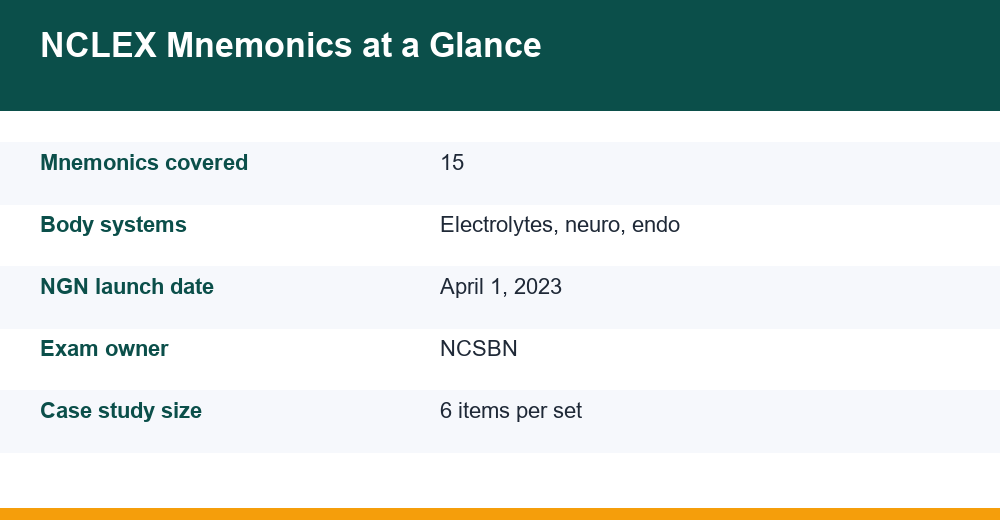
Yes, but they do a different job now. NCSBN launched the Next Generation NCLEX on April 1, 2023. It built the exam around the NCSBN Clinical Judgment Measurement Model, which breaks nursing thinking into six steps: recognize cues, analyze cues, prioritize hypotheses, generate solutions, take action and evaluate outcomes.
In the test plans published by NCSBN, the organization that develops the exam, a case study is a set of six items, one for each of those steps. A mnemonic mostly helps with the first two. It gets you to notice that peaked T waves, muscle weakness and low urine output belong together. The later steps depend on what you do with that cluster.
So treat every memory aid as a cue-recognition shortcut, not as the answer. In this guide, each mnemonic comes with the follow-up questions an NGN item is likely to ask. What is the priority? What do you do first? How will you know it worked?
What are the best mnemonics for the NCLEX?
The most useful NCLEX mnemonics cover high-risk content that keeps coming back in client-safety questions:
- Electrolytes: MURDER (hyperkalemia), low and slow (hypokalemia), CATS (hypocalcemia), stones-bones-groans-moans (hypercalcemia)
- Neuro: a pair of cranial nerve sentences, one for names and one for function
- Endocrine: fifteen-thirty-two-flat for insulin timing, clear before cloudy, cold and clammy
- Pharmacology: SLUDGE, the anticholinergic similes, digoxin yellow halos, BURP for magnesium sulfate
- Complications and safety: the 6 Ps, ROME for ABGs, RACE and PASS
Electrolyte NCLEX Mnemonics: Potassium, Calcium and More
Electrolyte imbalances are a good fit for memory aids because the signs follow patterns. Learn the normal ranges first. Our guide to the lab values the NCLEX expects you to know covers them in more detail.
| Electrolyte | Typical adult range | Imbalance mnemonic | Key ECG clue |
|---|---|---|---|
| Potassium | 3.5–5.0 mEq/L | MURDER (high) / low and slow | High: peaked T. Low: flat T, U wave |
| Calcium (total) | about 9.0–10.5 mg/dL | CATS (low) / stones, bones (high) | Low: long QT. High: short QT |
| Sodium | 135–145 mEq/L | Neuro changes in both directions | Not a primary ECG marker |
| Magnesium | about 1.3–2.1 mEq/L | Mirrors calcium in reflexes | Low: torsades risk |
Reference ranges differ a little between labs and textbooks. On the exam and on the unit, use the range you are given.
What is the mnemonic for hyperkalemia signs?
MURDER is the classic one:
- Muscle weakness and cramps
- Urine: oliguria or anuria, often from kidney injury
- Respiratory distress as the respiratory muscles weaken
- Decreased cardiac contractility
- ECG changes: tall peaked T waves, a widened QRS, flattened P waves
- Reflexes: hyperreflexia early, then areflexia
NGN context: the cardiac cues come first. A potassium of 6.2 mEq/L with a widened QRS in a client with renal failure points to cardiac monitoring and an immediate call to the provider. Expect the provider to consider calcium gluconate to protect the heart and insulin with dextrose to shift potassium into cells. After that, re-checking the potassium and the rhythm is how you evaluate outcomes.
Hypokalemia: low and slow
With low potassium, everything slows down. Look for muscle weakness, leg cramps, constipation or ileus, shallow breathing and flat or inverted T waves with a prominent U wave. Loop diuretics are a common cause. Low potassium also raises the risk of digoxin toxicity, a link that shows up often in case studies.
Calcium: CATS and stones, bones, groans, moans
CATS stands for hypocalcemia: Convulsions, Arrhythmias, Tetany and Spasms or stridor. Two signs to know are Chvostek’s (the face twitches when you tap over the facial nerve) and Trousseau’s (the hand spasms while a blood pressure cuff is inflated). Watch for this after thyroid or parathyroid surgery, where laryngospasm makes it an airway priority.
Hypercalcemia does the opposite: stones (kidney stones), bones (bone pain), abdominal groans (constipation, nausea) and psychiatric moans (confusion, lethargy). Reflexes get weaker and the QT shortens.
How to Memorize the Cranial Nerves for Nursing
Use two sentences in parallel. The first gives you the names in order. The second tells you whether each nerve is sensory, motor or both. Together they count as one memory aid in this list.
- Names: “Oh Oh Oh To Touch And Feel Very Good Velvet, Ah Heaven” for Olfactory, Optic, Oculomotor, Trochlear, Trigeminal, Abducens, Facial, Vestibulocochlear, Glossopharyngeal, Vagus, Accessory, Hypoglossal
- Function: “Some Say Marry Money, But My Brother Says Big Brains Matter More” (S = sensory, M = motor, B = both)
| Nerve | Name | Type | Bedside check and NCLEX link |
|---|---|---|---|
| I | Olfactory | Sensory | Identify a familiar smell |
| II | Optic | Sensory | Visual acuity and fields |
| III, IV, VI | Oculomotor, Trochlear, Abducens | Motor | Six cardinal gazes; III also controls pupil response, a key sign of rising ICP |
| V | Trigeminal | Both | Facial sensation, corneal reflex, chewing |
| VII | Facial | Both | Facial symmetry, taste on the front of the tongue (Bell’s palsy, stroke) |
| VIII | Vestibulocochlear | Sensory | Hearing and balance; watch for ototoxic drugs |
| IX, X | Glossopharyngeal, Vagus | Both | Gag reflex and swallowing before oral intake |
| XI | Accessory | Motor | Shoulder shrug against resistance |
| XII | Hypoglossal | Motor | Tongue midline when protruded |
NGN context: after a stroke, an absent gag reflex (IX and X) is the cue that counts. The safe action is to keep the client NPO until a swallow screen is done. A unilaterally dilated, sluggish pupil (III) in a head-injury client is an emergency cue, not just an exam finding.
Insulin Onset and Peak: Memory Aids for Timing
The question that comes up most is when hypoglycemia is most likely. That happens around the peak. One easy chain is “fifteen, thirty, two, flat”: rapid-acting starts in about 15 minutes, regular in about 30, NPH in about 2 hours, and glargine has no real peak.
| Insulin | Approx. onset | Approx. peak | Approx. duration |
|---|---|---|---|
| Rapid (lispro, aspart) | about 10–15 min | about 1–2 h | 3–5 h |
| Short (regular) | 30–60 min | 2–4 h | 5–8 h |
| Intermediate (NPH) | about 1–2 h | 4–12 h | about 12–18 h |
| Long (glargine U-100) | about 1–4 h | no pronounced peak | about 24 h |
These figures are approximate and drug references don’t all agree. Go by your facility’s reference or the product label.
What mnemonic helps with insulin onset and peak?
Besides fifteen-thirty-two-flat, three short phrases cover most exam questions:
- Clear before cloudy: when mixing regular with NPH in one syringe, draw up the clear regular insulin first so NPH doesn’t contaminate the regular vial.
- Rapid means the meal is on the tray: because lispro starts so fast, it is given close to eating.
- Glargine goes flat: no peak means you don’t mix it with other insulins and it gives steady basal coverage.
Cold and clammy, need some candy
Cool, sweaty, shaky skin points to hypoglycemia. “Hot and dry, sugar high” points to hyperglycemia. If the client can swallow safely, follow the 15-15 rule: give about 15 g of fast-acting carbohydrate and recheck glucose in 15 minutes. If they cannot swallow, IV dextrose or glucagon is the expected next step.
Pharmacology Memory Aids for Toxicity and Side Effects
Drug questions are usually about safety rather than recall. These four memory aids cover toxicity patterns that come up again and again. For a system-by-system approach, see our NCLEX pharmacology study strategy.
SLUDGE: cholinergic excess
Salivation, Lacrimation, Urination, Defecation, GI upset, Emesis. Think of organophosphate poisoning or too much of a cholinesterase inhibitor in myasthenia gravis. Bradycardia and bronchial secretions make airway the priority. Atropine is the classic antidote.
The anticholinergic similes
“Dry as a bone, red as a beet, blind as a bat, hot as a hare, mad as a hatter, full as a flask.” These are dry mouth, flushing, blurred vision from dilated pupils, hyperthermia, confusion and urinary retention. Older adults on diphenhydramine or similar drugs fit this pattern, and it raises their fall and delirium risk.
Digoxin: yellow halos, hold the dose
Early signs of toxicity are nausea, vomiting and loss of appetite. Next come visual changes such as yellow-green halos, then bradycardia and dysrhythmias. Take the apical pulse for one full minute before giving digoxin. A typical adult hold parameter is a pulse under 60, though you follow the order.
Check the potassium too, because hypokalemia increases toxicity risk. A commonly cited therapeutic range is 0.5–2.0 ng/mL, and lower targets are often used in heart failure.
BURP: magnesium sulfate toxicity
In preeclampsia, watch for Blood pressure dropping, Urine output falling, Respiratory depression and Patellar reflexes disappearing. Nursing texts commonly cite a respiratory rate under 12 and urine output under 30 mL/h as warning thresholds. The expected action is to stop the infusion and notify the provider. Keep calcium gluconate at the bedside as the antidote.
Complication, ABG and Safety Mnemonics
The 6 Ps of compartment syndrome
Pain out of proportion to the injury and worse with passive stretch, Paresthesia, Pallor, Paralysis, Poikilothermia (a cool limb) and Pulselessness. The most important point is that pain and paresthesia show up early, while pulselessness is a late sign. Waiting for a missing pulse means acting too late.
NGN context: after a cast or fracture, pain that opioids don’t relieve is the cue. Appropriate actions are keeping the limb at heart level instead of raising it, loosening constrictive dressings as ordered, and notifying the provider right away.
ROME for arterial blood gases
Respiratory Opposite, Metabolic Equal. In respiratory problems, pH and PaCO2 move in opposite directions. In metabolic problems, pH and HCO3 move in the same direction.
With typical normals (pH 7.35–7.45, PaCO2 35–45 mm Hg, HCO3 22–26 mEq/L), a pH of 7.30 with a PaCO2 of 55 is respiratory acidosis. Then link it to the cause, such as opioid oversedation or a COPD exacerbation.
RACE and PASS for fire safety
- RACE: Rescue clients in immediate danger, Alarm, Contain the fire by closing doors, then Extinguish or Evacuate.
- PASS: Pull the pin, Aim at the base of the fire, Squeeze the handle, Sweep side to side.
Safety and Infection Control is a client-needs subcategory in both the RN and PN test plans. Priority-order questions here often follow these sequences closely.
Mistakes That Show Up in Popular Mnemonic Lists
Lists of NCLEX mnemonics get copied from site to site, and errors spread with them. Before you memorize anything, check it against a textbook or drug reference. These are the slips seen most often:
| Common error | Correct version | Why it matters |
|---|---|---|
| Flat T waves listed under hyperkalemia | Hyperkalemia gives peaked T waves; flat T and U waves mean hypokalemia | Mixing these up reverses the treatment |
| Chvostek and Trousseau linked to high calcium | Both are signs of hypocalcemia (and often low magnesium) | Missed tetany can progress to laryngospasm |
| SLUDGE described as anticholinergic | SLUDGE is cholinergic; anticholinergic is dry, hot, red | The antidotes are opposites |
| Pulselessness taught as an early 6 Ps sign | Pain and paresthesia come early; pulselessness is late | Delay risks permanent tissue loss |
| Cranial nerve VIII called the auditory nerve only | Vestibulocochlear covers hearing and balance | Ototoxic drugs can cause dizziness as well as hearing loss |
| Insulin times given as exact numbers | Times are ranges and vary by reference | Overly precise numbers can lead you to the wrong answer |
A good rule: if you can’t explain why each letter is true, the mnemonic is a liability. Understanding the physiology lets you rebuild a forgotten mnemonic from scratch. Memorizing letters alone won’t.
How to Study With NCLEX Mnemonics Without Leaning on Them
Spend a little time on memory aids and a lot of time applying them. This routine for NCLEX mnemonics works for RN and PN candidates alike:
- Learn the mechanism first. Know why potassium affects cardiac conduction before you learn MURDER.
- Write it out cold. Each day, write out three mnemonics from memory and explain every letter in one line.
- Attach an action. For each one, write the priority intervention and how you would evaluate it.
- Test it with case studies. Do NGN-style practice sets and note which cues you missed.
- Retire what you know. Once a concept is automatic, stop drilling its mnemonic and move on.
PN candidates should focus on the aids tied to data collection, reinforcing teaching and medication safety: hypoglycemia, digoxin checks, the 6 Ps and fire safety. Our NCLEX-PN study guide shows how to fit these into a full schedule.
Last, a word of caution. NCLEX mnemonics help you recall facts, but the exam scores your judgment. The real NCLEX rewards candidates who see a set of cues, rank the risks and act safely. Use these aids to make that first step faster, then put most of your study time into the reasoning that follows.
Frequently Asked Questions
Are mnemonics useful for Next Generation NCLEX questions?
Yes, mainly for the recognize-cues and analyze-cues steps of NCSBN’s clinical judgment model. A mnemonic helps you spot a group of related findings fast. NGN case studies then ask you to rank hypotheses, pick actions and evaluate outcomes. Pair each mnemonic with a priority intervention and a way to check that it worked.
What is the mnemonic for hyperkalemia signs?
MURDER: muscle weakness, urine changes (oliguria), respiratory distress, decreased cardiac contractility, ECG changes and reflex changes. The ECG changes are tall peaked T waves, a widened QRS and flattened P waves. Cardiac cues come first, so expect cardiac monitoring and prompt provider notification. Calcium gluconate is commonly used to stabilize the heart.
How do you memorize cranial nerves for nursing?
Use two sentences. “Oh Oh Oh To Touch And Feel Very Good Velvet, Ah Heaven” gives the twelve names in order. “Some Say Marry Money, But My Brother Says Big Brains Matter More” tells you whether each is sensory, motor or both. Then link each nerve to a bedside check, such as the gag reflex for IX and X.
What mnemonic helps with insulin onset and peak?
Try “fifteen, thirty, two, flat.” Rapid-acting insulin starts in about 15 minutes, regular in about 30, NPH in about 2 hours, and glargine has no pronounced peak. Hypoglycemia risk is highest around the peak. All times are approximate and vary by reference, so check your facility’s drug guide.