
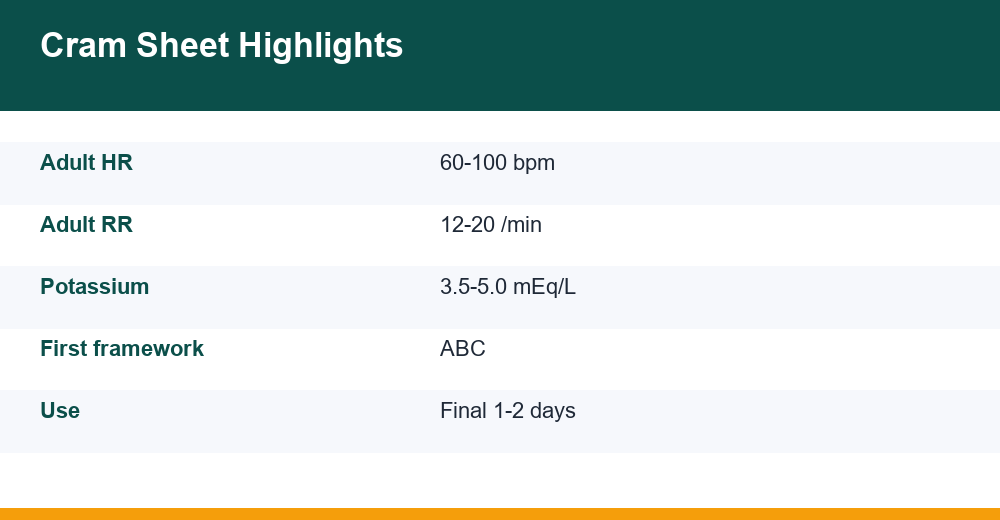
An NCLEX cram sheet is your final-days friend: a compact summary of the highest-yield facts you have already learned, gathered in one place for quick review. This NCLEX cram sheet pulls together vital signs, top lab values, key antidotes, positioning, delegation and the priority frameworks — the facts most likely to earn quick marks. Use it to refresh, not to learn new material at the last minute.
This guide is for study and revision only and may contain errors. Always follow your program, your drug reference and your facility protocols, and verify before acting.
Table of Contents
How to use this cram sheet
A cram sheet works only as a top-up on real preparation. In the final day or two before the exam, read through these high-yield facts to keep them fresh, then rest — sleep does more for exam performance at that point than more studying. Do not try to learn new topics from a cram sheet; its value is in consolidating what weeks of question practice have already built. For the full preparation, see our NCLEX study plan.
Normal vital signs
| Vital sign | Adult normal range |
|---|---|
| Heart rate | 60-100 beats/min |
| Respiratory rate | 12-20 breaths/min |
| Blood pressure | around 120/80 mmHg |
| Temperature | 36.5-37.5 C (97.7-99.5 F) |
| Oxygen saturation | 95-100% |
Top lab values
These are the values most likely to drive a nursing action. For the full set, see our NCLEX lab values cheat sheet.
| Lab | Normal range |
|---|---|
| Potassium | 3.5-5.0 mEq/L |
| Sodium | 135-145 mEq/L |
| pH | 7.35-7.45 |
| Platelets | 150,000-400,000 /mm3 |
| INR (on warfarin) | 2.0-3.0 |
Antidotes to remember
| Drug | Antidote |
|---|---|
| Warfarin | Vitamin K |
| Heparin | Protamine sulfate |
| Opioids | Naloxone |
| Acetaminophen | Acetylcysteine |
| Magnesium sulfate | Calcium gluconate |
Priority frameworks
When a question asks what to do first, apply ABC (Airway, Breathing, Circulation) first, then Maslow (physiological needs before psychosocial), then acute-over-chronic and unstable-over-stable. For delegation, keep assessment, teaching, evaluation and unstable patients with the RN. The full method is in our prioritization and delegation guide.
Positioning & precautions
High-yield positioning facts include: place a post-operative unconscious patient on their side to protect the airway; use semi-Fowler’s for respiratory distress; position on the left side for pregnancy to improve perfusion; and keep the affected limb elevated after certain surgeries. For precautions, remember the transmission-based categories — airborne, droplet and contact — covered in our infection control guide. These small facts appear often and are easy marks.
Final review
The night before the exam, skim your cram sheet once, confirm your ID and test-centre logistics from our test day guide, and get a full night’s sleep. Confidence built on weeks of question practice, topped up by a quick review of these high-yield facts, is exactly the state you want to walk in with. Authoritative exam information is on the NCSBN website.
Frequently Asked Questions
What is an NCLEX cram sheet?
An NCLEX cram sheet is a one-page summary of the highest-yield facts — vital signs, key lab values, antidotes, positioning and priority rules — used for quick review in the final days before the exam.
What are normal adult vital signs for the NCLEX?
Roughly: heart rate 60-100 bpm, respiratory rate 12-20/min, blood pressure around 120/80 mmHg, and temperature about 36.5-37.5 C (97.7-99.5 F).
Is cramming effective for the NCLEX?
Cramming cannot replace weeks of question practice, but a well-made cram sheet is useful in the final day or two to refresh high-yield facts you already learned.
What should I review the day before the NCLEX?
Light review of a cram sheet — vital signs, top lab values, antidotes and priority frameworks — then rest. Avoid learning new material the day before.